Saturday, December 01, 2018
Wednesday, February 24, 2016
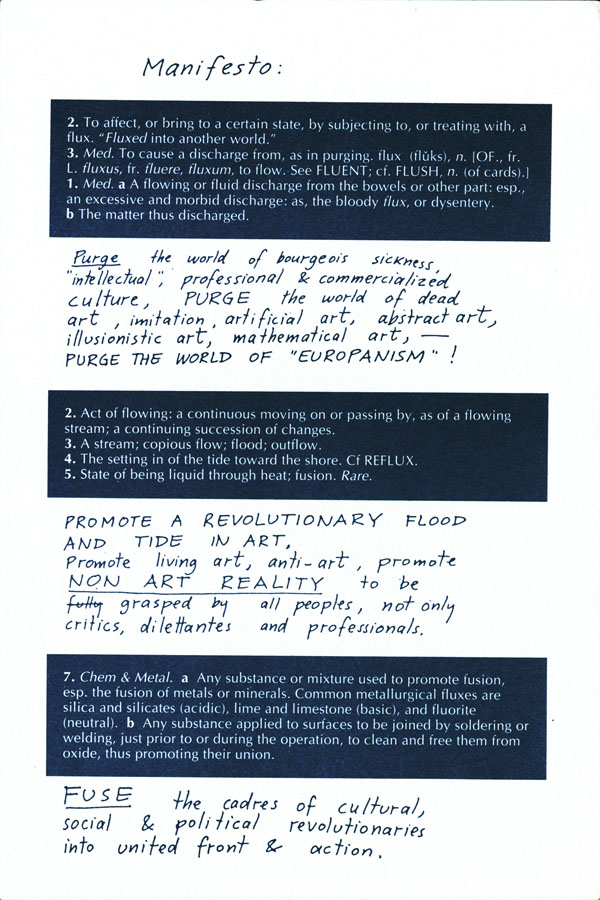
Article by Clive Phillpot - Manifesto I
Manifesto I
FLUXUS: MAGAZINES, MANIFESTOS, MULTUM IN PARVO
By Clive Phillpotsource: http://georgemaciunas.com/about/cv/manifesto-i/

Labels: Clive Phillpot, Fluxus, Manifesto
Monday, December 14, 2015
Horns
The Handmade Horns and Drone Music of a Fluxus Composer

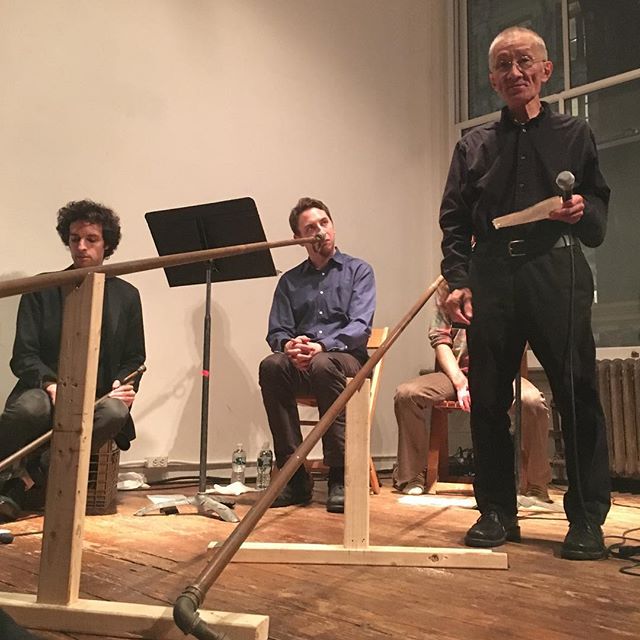
Foundation (photo by @thehouseofdis/Instagram)
Tashi Wada, Yoshi’s son and an accomplished composer in his own right, kickstarted the performance with a mid-frequency hum generated by an organ. After a few minutes, two short, higher-pitched horns entered the mix. The players held the notes interminably, with subtle differences in pitch prompting a rhythmic pattern that felt embedded into the surfaces of the room. Then two larger horns — each roughly 20 feet long, stretching across the floor — entered, one providing an impossibly deep backbone to the existing swirl of sounds, the other punctuating the dense composition with shorter, slightly higher moans. Once each instrument had been introduced, they began to cycle in and out according to Wada’s diagrammatic score, in a way that kept the sound in constant yet nearly negligible flux — wavering and shifting second by second in microscopic increments. Calm but never silent (indeed, often quite loud), Wada and his cohorts breathed — or rather, blew — organic life into calculated minimal music that could, in the hands of lesser musicians, be a bit “boring.”
Wada’s approach to drone music, like that of many of his contemporaries, draws inspiration from, on the one hand, various musical traditions of east and south Asia, and on the other, the post–John Cage American avant-garde. (Wada notably studied Scottish bagpipe music as well.) Born in Japan but based in the United States for nearly 50 years, Wada rose to prominence in the late 1960s as a member of the international art collective Fluxus. By the time he composed “Earth Horns,” drone music had represented the crux of the Fluxus musical practice for several years. The collective’s best-known composer at the time, La Monte Young, proffered a brand of drone based on pitch ratios that, in his view, had been reverberating throughout the cosmos since the beginning of time. As if to drive this notion home, Young called his group the Theatre of Eternal Music. Wada and Young’s Fluxus associations (as well as their mutual kinship with the great Hindustani vocalist Pandit Pran Nath) might suggest that the two composers share similar approaches to drone. But Wada’s performance at Emily Harvey made it clear — if the title, “Earth Horns,” hadn’t already — that he and Young ultimately exist in different realms: one terrestrial, one extra-. Young’s perpetual installation “Dream House,” for example, on display this summer at Dia:Chelsea and otherwise in Tribeca, prods visitors toward transcendence with bright purple lights, images of eastern spiritual leaders, an imperative to take off your shoes because of the carpeted floor, and above all, humming drone music playing from speakers hung near the ceiling.
Saturday, October 12, 2013
Performa Arts : Fluxus Weekend
Fluxus Weekend
In the spirit of Fluxus, Performa will produce an intensive 52-hour program across New York City, collaborating with members of the Performa Consortium. A five-part program will be presented in several key Fluxus forms, honoring the history and prompting the making of new Fluxus actions, objects, music, film, and ideas for the twenty-first century. The projects, ranging in size from large events to small-scale gestures, will be concentrated in downtown Manhattan in tribute to Fluxus history, and to George Maciunas and the Fluxus pioneers who lived and worked there.
source: http://11.performa-arts.org/performa-presents/fluxus-weekend
Labels: Fluxus, Fluxus Arts, Fluxus Weekend, New York
Fluxus in Britannica
The name Fluxus, meant to suggest both “flow” and “effluent,” was coined by Fluxus founder George Maciunas (1931–78), a Lithuanian American designer and “cultural entrepreneur.” Maciunas used the word fluxus to describe a wide range of his activities, from a published call for a common front of artists against culture to a New York artists’ housing association, as well as a publishing concern that produced ephemeral interactive multiples and staged live events called Happenings that were precursors to performance art, video art, and other progressive art forms.
In its early years, from 1962 to 1966, Fluxus fused conceptual art, minimalism, new music, poetry, and chance-based work into an intermedia phenomenon, identifiable more through its irreverent attitude toward art than through the use of any distinct style. Utilizing humour—in the spirit of Dada—and everyday materials and experiences, Fluxus created original and often surprising objects and events. The Fluxus event, sometimes a minimal live gesture initially presented as part of a concert or a poetry reading, was researched and developed in part from ideas collected by the American experimental musician La Monte Young and published by him and the American poet and playwright Jackson Mac Low in 1963 as An Anthology of Chance Operations…. This publication—which collected “chance operations, concept art, anti-art, indeterminacy, plans of action, diagrams, music, dance constructions, improvisation, meaningless work, natural disasters, compositions, mathematics, essays, [and] poetry”—was designed by Maciunas and formed much of the material for his “Festum Fluxorum,” a European tour of 1962–63 during which Fluxus became an official movement and its international character was confirmed.
From 1964 Maciunas designed, produced, and promoted hundreds of multiples: a remarkable range of objects from tiny books of compositions to uniquely altered attaché cases with compartments full of games in small plastic boxes, plus films, records, jokes, miniature environments, posters, and charts using imagery publicly available from the New York Public Library. All Fluxus production was driven by a utilitarian philosophy in which colour, scale, material, and font were secondary to affordability and available space—a format that brought coherence to the otherwise heterogeneous Fluxus style. More than 30 individuals, from Christo to Yoko Ono, collaborated with Maciunas, who interpreted their ideas, whether for a chess set or for an apron, into multiple forms. Produced on demand by hand, using volunteer labour and the cheapest material, these provocative and amusing items were deliberately ephemeral, inexpensive, and intended for use rather than display.
source: http://www.britannica.com/EBchecked/topic/1345511/Fluxus
Labels: Britannica, Fluxus
Monday, February 20, 2012
Art of healing

Feb 19, 2012 :
Yoko Ono’s work highlights the importance of imagination, collective thinking, courage and women power, writes Giridhar Khasnis.
Extraordinary : Yoko Ono’s ‘Remember Us’. Photo by Briana Blasko © yoko ono‘Our Beautiful Daughters’ is the title of the first ever solo show in India of Tokyo-born New York-based conceptual artist Yoko Ono. With its multiple installations, video films, and photographic images, the exhibition — on at Vadehra Art Gallery, Delhi (till March 10) — exemplifies some of Ono’s continuing beliefs, wishes and concerns.
“Our beautiful daughters of the planet: each one of us is a being sent to earth to bring peace and happiness for all,” writes Yoko Ono. “Let’s have a clear vision about this. And know that this is the time to heal the world with WOMEN POWER. We can do it, and we will.”
Speaking of her prolific career as a peace activist, musician, performer and multi-media artist, gallerist Arun Vadhera explains how Ono’s fame cuts across generations; and how her work blurs the boundaries between everyday life and art, and between spiritualism, poetry and political action.
“It is metaphysical, ephemeral and conceptual while all the time remaining accessible to the viewer. It invites participation and introspection from the audience and in fact depends wholly on this response for its activation and fruition as an art work... The exhibition highlights the importance of peace, healing, the power of collective thinking, imagination, courage, and of course women power, all of which are at the core of Yoko Ono’s practice.”
The central piece of the exhibit is ‘Remember Us’ (2012), a haunting artwork occupying the space of an entire floor. In the dimly lit interiors, more than a dozen black, coffin-like boxes are neatly laid out. Each box is filled with tiny charcoal briquettes on which lies the cast of a dismembered woman’s body — unclothed and lifelike, frightening and engaging in colour, texture and blatancy.
Ono urges the visitors to touch the bodies ‘and in the process come to terms with their feelings of compassion, love, empathy, identification, aggression, violence, acceptance, vulnerability and power that this acts of touching unleashes in them.’
The truly disturbing piece of art evokes multiple and often conflicting thoughts, even as it demystifies the sexual aura of the human body. Adding to the disquiet, bowls containing ashes are placed at the farther end of the gallery. On one of the walls, Ono has splashed dripping black paint which reads, in one instance ‘Uncurse yourself’; and in the other, ‘I am uncursed’. Colourful odhnis (hand-embroidered by women artisans from Bikaner) hang on the walls of the room, while recorded sounds of Indian streets add to the audio-visual experience.
Among other interactive exhibits is the ‘Wish Tree’, a public art project Ono has been working on for more than a decade in different cities around the world. In this seemingly simple piece, potted plants are placed at different venues and the visitors are encouraged to write their wish, prayer or thought on a paper tag and tie it to the plant.
Several ‘wish trees’ have found their way into public and private spaces in Delhi like schools, hospitals, galleries, and book shops.
In ‘Mend Piece’, the 78-year-old artist has placed shattered ceramic pottery pieces on a table; visitors are told to bring them back to life by taping, and gluing the broken pieces — as a symbolic gesture of mending all those things which are broken up in the world.
Similarly, for the ‘Heal Together’ work, the artist has slashed a large canvas; the audience, once again, are welcomed to stitch paper, cloth and other things on it. Another piece which has invited curious glances of Delhiites is the set of large hoardings with a single word ‘Touch’ inscribed on them.
The parallel exhibition titled ‘The Seeds’ places Ono’s works in context through videos, films and photographs; they include some of her famous performances, installations and artistic collaborations made over the past decades. Featured among them is her well-known ‘Instructions’ series which began in early 1960s and is considered to be one of the pioneering works in conceptual art.
Yoko Ono was born in Tokyo in 1933 and moved to New York when she was 20 and studied music and poetry at Sarah Lawrence College. She became an important member of the avant-garde ‘Fluxus’ movement in the 1960s, establishing herself as a daring, innovative and eccentric artist-performer of her time.
“As one of the founders of the Fluxus movement, Ono helped identify and define the playful, subversive, visionary sensibility that has undergirded experimentation in all the arts ever since,” recalls curator and art critic Peter Frank. “Her poem-like verbal scores, her films, and her staged performances anticipated everything from minimalism to performance art, the furthest reaches of new cinema to the most extreme of Punk-New Wave music...
With her Fluxus colleagues Ono elevated the insubstantial to monumental status, allowing us to contemplate the magic of the ordinary, as well as to comprehend the ordinariness of the seemingly profound. This inversion, along with the inventive puckishness of her game-like concepts and activities, make her work endlessly provocative — at once irksome and inviting, loopy and lovely, teasing and teaching us to appreciate the intimate and elusive phenomena that comprise life.”
In 1969, Ono married John Lennon (1940 – 1980), the legendary singer-songwriter and one of the founding members of The Beatles. Together, they were actively involved in numerous campaigns supporting world peace and anti-war issues. Even after the tragic death of Lennon in 1980, Ono continued to communicate her message of love and peace through her music and performances. She gave stirring speeches appealing, among others, for the abolition of nuclear weapons.
Winner of many international awards and honours, Ono has, over the decades, regularly set up her exhibitions and performances across the globe. She was awarded the Golden Lion for Lifetime Achievement from the Venice Biennale in 2009.
Ono has always pleaded for love, compassion and understanding. “Peace is here now,” she says. “It’s just that we don’t recognise it. About 98 per cent of people in the world are wanting peace. The two per cent is really trying to mess it up.”
In 2011, she received the 8th Hiroshima Art Prize for her contributions to world peace through contemporary art and for “the substantial role her activities have in transmitting the message of the ‘Spirit of Hiroshima’ throughout the entire world.”
source:http://www.deccanherald.com/content/228234/art-healing.html
Sunday, February 05, 2012
Fluxus at 50

Artists commonly fall into the category of self-ascribed autonomists. More than most working practises; the traditional notion of the artist is one who works alone, behind the closed doors of their studio, grappling with their own creativity. The desire to channel it can enrapture an artist for most or their entire career. By default, this can leave little room for interdisciplinary experiments, collaborative efforts or even an awareness of the context of their work within a wider socio-economic framework. In the early 60’s however, a young and politically charged generation was emerging and New York saw a confluence of artists from a multi-disciplinary background, starting to work in parallel – generating a series of ‘happenings’ and redefining the way in which art is made, presented and perceived. The redistribution of art, from the hands of the elite to the general public, had begun. The central movement that was to evolve from this new democratic approach was ‘Fluxus’: an international network of avant-garde artists, architects, composers, and designers – noted for blending different artistic media and disciplines, and promoting their work in the format of multiples or ‘artist editions’. The affordable and portable publication became the Fluxus Edition vehicle of choice and enabled artists to show their work on an international scale, and to a much wider audience. At the helm of this community was George Maciunas – a Lithuanian born, American artist – who had been inspired to found Fluxus after attending John Cage’s Experimental Music Composition classes at the New School for Social Research. A forerunner in the art of subversion, Cage’s most controversial composition was and remains ‘4.33’, three movements of which are performed without a single note being played. The content of the composition is entirely made up of the sounds of the environment that the listeners hear throughout its duration. In the visual arts, a similarly provocative piece of work might be attributed to Marcel Duchamp who dubbed a urinal art and named it ‘Fountain’ in 1917. This radical interpretation of art – largely ushered in by Dadaism, and of which Cage and Duchamp are just two of many examples – was highly influential and provoked people to question conventional art practises. By the time Fluxus came to fruition 35 years later in 1962, subversion as a theme was in itself nothing new, but the social changes at the time at which it arose would be reflected and captured in much of its output, making Fluxus a defining moment in the history of art.
Fluxus was born during a period of rapid advancement in mechanical production, when the relationship between maker and object was becoming increasingly dispensable. At its core was the re-appropriation of production and an integral involvement with material: analysing objects and actively using technology to their own artistic end. Examples of this include Joe Jones’ ‘Mechanical Violin’, Yasunao Tone’s ‘Anagram for Strings’ and George Maciunas’ ‘12 Big Names!’ 1975, and ‘Flux Cabinet 1975-77’. In their output of printed matter, Fluxus artists juxtaposed the making of multiples in the hundreds and thousands alongside the retention of a handmade ownership; this is what makes Fluxus work so engaging: art for everyone, the promotion of the ‘readymade’ and the physical multiplication of a singular artistic idea without diluting quality or succumbing to consumerist ambition.
To coincide with the 50 year anniversary of Fluxus, the past 12 months saw New York playing host to exhibitions and performances that paid tribute to the seminal art movement. Performa, the biennal festival dedicated to performative works staged a ‘Fluxus Weekend’, NYU’s Grey Art Gallery had an exhibition dedicated to ‘Fluxus and the Essential Questions of Life’, and currently on view at the MOMA is ‘Thing/Thought: Fluxus Editions, 1962-1978’, a concise but comprehensive collection of works that emerged from Fluxus Editions. Presenting work by George Maciunas, Nam June Paik, La Monte Young, Peter Moore, Yasunao Tone, Yoko Ono and George Brecht among others, the MOMA exhibit presents one of the largest collections of Fluxus work of its kind and highlights the use of art multiples and their primary medium of printed matter. The work is visually arresting and exciting, exploring ideas of politics and pop culture with a playful overtone.
American life was in a state of transition, trying to find a foothold between the old and the new. More so than today, young people were acutely engaged in ‘movements’; everyone wanted to be a part of something. Fluxus undoubtedly absorbed a lot of the energy of that period and it is reflected in the interplay between media (dubbed ‘intermedia’ by Fluxus artist Dick Higgins), as well as the artistic collaborations it promoted. The scope of the Fluxus outreach was vast and directed not to the art world but to the general populace.
Performa’s ‘Fluxus Weekend’ nicely balanced out the object and print-heavy content of the MOMA show with its reflection on the performative aspects of Fluxus. The intensive weekend included ‘The Ginger Island Project’, a group exhibition at the Emily Harvey Foundation, based on George Maciunas’ desire to start a community of Fluxus artists on a Caribbean Island and Guido van der Werve’s 30-mile jog from Manhattan to Valhalla in upstate New York, as well as performances by Bibbi Hansen, Lumberob, Haribos and countless others. Anthology Archives, a jewel in the crown of NYC’s independent film scene, screened Jonas Mekas’ latest film, ‘Fluxus Cabaret’. Mekas, a godfather of avant-garde cinema and one of the leading members of Fluxus art also founded Anthology and so the lo-fi aesthetics of his film, reminiscent of a home movie, seemed quite at home in Anthology’s humble surroundings. The film was a comprehensive collection of works performed by Nam June Paik, Ben Vaultier, Joseph Beuys, Yoko Ono and several others; a sort of director’s cut of Fluxus. Mekas himself was at the screening, and afterwards fielded questions in the lobby, revelling in the enthusiasm of the young crowd that had turned out.
The exhibitions and events that paid homage to Fluxus over the past few months were able to evoke the energy and the originality that encapsulated Fluxus. The sheer number of events staged, served to introduce a new generation to a movement that paved the way for much of the artistic license and expression of contemporary art. The question remains however, has Fluxus come and gone? A retrospective falls closely in line with a sense of finality and looking back with nostalgia is the antithesis of the Fluxus philosophy, which propagated the need to move forward and embrace the new. However, Fluxus was just a facet of a greater awakening of creative expression. It was the centralized body, a spokesperson as it were, for a strand of artistic innovation that was only representative of a greater whole, embodying themes of social and political change which are as relevant today as ever. The essence of Fluxus is there to be redefined and re-purposed, as the artworks themselves were intended. As New York finds itself celebrating 50 years of Fluxus, it continues into a new era, gifting young artists with an open-mind, a collaborative spirit and a sense of innovation that will no doubt reap artworks that will be celebrated in the 50 years yet to come.
Labels: Fluxus
Saturday, February 04, 2012
Freiheit, Fluxus und Feuer – Eine kurze Abhandlung über Kunst im Fernsehen
Als David Sarnoff, damals Chef der RadioCorporation of America, 1939 in seiner Rede zum Beginn des amerikanischen Fernsehprogramms von der „Geburt einer neuen Kunst“ (Simmons 1983, S. 14) sprach und es 14 Jahre später auch in Deutschland hieß „Das Fernsehen ist schon heute eine Kunst. Es wird mit Gewißheit die Kunst von morgen sein“ (Eckert 1953, S. 102 ), wurde die Hoffnung erweckt, dass bildende Kunst, Literatur und Theater nun endlich eine neue Plattform und sogar eine neue mediale Präsentationsform im Fernsehen gefunden hätten – jedweder Skepsis vonseiten der Kulturkritik zum Trotze.
Avantgardisten aus aller Welt, allen voran die Mitglieder der Fluxus-Bewegung wie Nam June Paik, Wolf Vostell oder Joseph Beuys, versuchten seitdem eine Möglichkeit zu finden, wie das neue Medium als experimenteller Distributionskanal für Kunst genutzt werden kann. Die Ergebnisse ihrer Bemühungen waren meist einmalige Kooperationen von Künstlern und Fernsehmachern wie Black Gate Cologne (1968), die Fernsehgalerie (1969) oder der Kunstkanal (1989) – eine längerfristige Produktion scheiterte entweder an dem Missfallen der Programmverantwortlichen oder an der Einschaltquote, „dem verborgenen Gott dieses Universums“ (Bordieu 1998, S. 33 ). Eben jenes Instrument der Programmregulierung sorgte in der Folgezeit schließlich dafür, dass experimentelle Fernsehkunstformate in das Programm der Offenen Kanäle und Spartensender verbannt wurden und eine Kunstpräsentation zunehmend im Rahmen von Bulletins und Dokumentationen stattfand (Vgl. Holtmann 2008, S. 187ff.). Was bleibt, ist das dumpfe Gefühl, dass sich David Sarnoff schlicht und ergreifend geirrt hat und es ganz so aussieht, als ob das Fernsehen nie eine eigene Kunstform entwickeln wird, da das ganze TV-Programm im Jahre 2012 n. Chr. von aufmerksamkeitsheischenden Formaten besetzt wird. Das ganze TV-Programm? Nein! Ein von unbeugsamen Studenten bevölkertes Fernsehteam hört nicht auf, dem Fernsehkunst-Embargo Widerstand zu leisten. Und siehe da, sie sind nicht allein: Während sich mit Phase 3 – video.kunst.zeit (BR-alpha) und Souvenirs from Earth (digitaler TV-Sender) neue Plattformen für Videokunst im Fernsehen entwickelt haben, setzt man sich bei west.art Meisterwerke (WDR) und in den Wiederholungen des TV-Erfolges 1000 Meisterwerke (u.a. 3sat) intensiv mit klassischen Gemälden und modernen Installationen auseinander. Und wem das nicht reicht, der muss einfach nur zwischen 3 und 4 Uhr nachts den Kinderkanal Super RTL einschalten: Das dort gezeigte Kaminfeuer ist eigentlich nichts anderes als die Adaption von Jan Dibbets „TV as a fireplace“ aus dem Jahr 1969. Jedenfalls zur damaligen Zeit galt das als ganz große Fernsehkunst...
Labels: Fluxus, Television
Saturday, January 07, 2012
1962 – 2012 Fluxus in Wiesbaden
Fluxus 50
1962 – 2012 Fluxus in Wiesbaden
Fluxus: Internationale Festspiele Neuester Musik lautete der Titel einer Reihe heute legendärer Veranstaltungen und Konzerte, die 1962 im Wiesbadener Städtischen Museum stattfanden. Sie markierten den Beginn einer Kunstbewegung, die bis heute entscheidenden Einfluss auf viele künstlerische Positionen ausübt.
Anlässlich des 50-jährigen Jubiläums veranstaltet die Stadt Wiesbaden, die seither als ein Ursprungsort der weltweiten Fluxus-Bewegung gilt, ein Fluxusjahr, an dem sich zahlreiche Institutionen und Kultureinrichtungen der Stadt beteiligen: Im Museum Wiesbaden wird eine Ausstellung über Geschichte und Praktiken von Fluxus gezeigt. Das Staatstheater bringt eine Inszenierung des Stückes SAM von Katharina Schmidt auf die Bühne, das die Rollenverteilung von Zuschauer und Akteur in der Kunst hinterfragt. Weitere Ausstellungen entstehen im Nassauischen Kunstverein, in einem eigens von Fluxus-Künstler Ben Patterson entworfenen Fluxus-Pavillons und im Kunsthaus Wiesbaden. Auf Schloss Freudenstadt werden tägliche Fluxus-Aktionen stattfinden, die die Besucher aktiv einbinden. Eine Filmreihe und eine Klangwerkstatt für Kinder und Jugendliche runden das Jubiläumsfestival ab.
Künstlerische Leitung: Alexander Klar, Elke Gruhn, Matthias Schenk, Ulrich Meyer-Husmann, Manfred Beilharz. Mitwirkende Künstler/innen: Benjamin Patterson (US), Alison Knowles (US), Ben Vautier (IT), Takako Saito (J), Emily Wardill (GB), Jimmy Robert (BR), Asil Sungu (TR), Katerine Seda (CZ), Armando Queiroz (BR), Johannes Stüttgen, Uwe Oberg, Dirk Marwedel, Wolfgang Schliemann, Axel Schweppe u.a.
Das Projekt findet an rund 15 verschiedenen Orten in Wiesbaden statt.
S parten:
| Termine: | ||
|---|---|---|
| 01.01.2012 - 31.12.2012 | verschiedene Orte, Wiesbaden | 1962 – 2012 Fluxus in Wiesbaden |
Kontakt:
Kulturamt Wiesbaden
Schillerplatz 1-2
65185 Wiesbaden
www.wiesbaden.de
Tuesday, September 20, 2011
Fluxus today (Berlin 21-22 Oct 2011)
Akademie der Künste, Berlin, October 21 - 22, 2011
Registration deadline: Oct 14, 2011
FLUXUS TODAY. Action Art in Performance, Research, Exhibition, Archive
Conference in preparation for the exhibitions „The lunatics are on the loose …“ EUROPEAN FLUXUS FESTIVALS 1962-1977.
As guest at Akademie der Künste | Hanseatenweg 10 | 10557 Berlin
21 - 22 Oct 2011 | in English
Discussions will focus on innovative presentations of action art, meeting academic standards as well as those of a broad public. The conference will reflect the specific situation of Fluxus, in which the classical boundaries between professions are blurred and artists are also archivists, art historians and curators also perform, and collectors research and curate as well. Performance interventions by Eric Andersen, Ben Patterson, Willem de Ridder and Tamas St.Turba will contribute to the intertwining of theory and practice. The conference takes place within the exhibition A ROOM FOR JOHN CAGE.
Concept: Petra Stegmann
PROGRAMME
Fri 21 Oct | 11 am - 6 pm | Akademie der Künste | Hanseatenweg 10 | 10557 Berlin
I.
RESEARCHING FLUXUS. EUROPEAN FLUXUS FESTIVALS 1962-1977
11 am - 1:30 pm
Henar Rivière (FU Berlin/Universidad Complutense de Madrid): IF WE CAN CALL EVERYTHING FLUXUS ... ON THE RELATIONSHIP BETWEEN FLUXUS AND ZAJ
Bertrand Clavez (Université de Rennes 2): FLUXUS IN FRANCE. AN ANTHOLOGY OF MISUNDERSTANDINGS
Peter van der Meijden (University of Copenhagen): WHIPPING POST COPENHAGEN
Heike Roms (Aberystwyth University): CAN A NETWORK HAVE MARGINS? WHEN FLUXUS CAME TO WEST WALES (1968)
Petra Stegmann (Potsdam): FLUXUS CONCERTS IN EASTERN EUROPE. THE LOCAL PERSPECTIVE
chair: Elisabeth Delin Hansen (Nikolaj Kunsthal Copenhagen)
II.
Johannes Odenthal (Akademie der Künste Berlin): A ROOM FOR JOHN CAGE. Curator’s tour of the exhibition
2:30 – 3:15 pm
III.
EXHIBITING FLUXUS – DOCUMENTATION AND PARTICIPATION
3:15 - 6 pm
Matthias Krohn (Fachhochschule Potsdam): INTERACTIVE DESIGN PROJECTS FOR A DIGITAL FLUXUS ARCHIVE
Astrit Schmidt-Burkhardt (FU Berlin): MACIUNAS’ LEARNING MACHINES. VISUAL REPRESENTATION IN THE PREDIGITAL AGE
Zsuzsa László (tranzit.hu): BETWEEN TEXT AND PERFORMANCE
————————————————————
OPENING
TOTALLY FLUXED UP
Fri 21 Oct | 8 pm
SCHAU FENSTER – Schauraum für Kunst | Lobeckstr. 30-35 | 10969 Berlin
Eric Andersen | THE IDLE WALK
IPUT (superintendent: Tamas St.Turba) | OCCURRENCE
Ben Patterson | BRING HAMMER AND NAILS
Willem de Ridder | FLUTE CONCERT / MANIPULATION EVENT
————————————————————
Sat 22 Oct | 11 am - 6 pm | Akademie der Künste | Hanseatenweg 10 | 10557 Berlin
IV.
COLLECTING FLUXUS. FROM ACTION TO OBJECT
11 - 11.30 am
Harry Ruhé (Fluxus collector Amsterdam): THE ADVENTURE OF COLLECTING EPHEMERAL ART
V.
PERFORMING FLUXUS. PRACTICE AND RECEPTION
11:30 am - 1:30 pm
Hannah Higgins (University of Illinois Chicago): THE EVENT SCORE: A CASE AGAINST REPERFORMANCE
Gunnar Schmidt (Fachhochschule Trier): THE ART OF PIANO DESTRUCTION. FLUXUS BETWEEN POPULAR ENTERTAINMENT AND SHOCK THERAPY
THE FLUX-LABYRINTH IN BERLIN 1976. EYE-WITNESS-INTERVIEW
VI.
INSTITUTIONALIZING FLUXUS. ARCHIVES AND ACCESSIBILITY
2:30 - 6 pm
Skaidra Trilupaityt? (Lithuanian Culture Research Institute, Vilnius): THE GLOBAL INDUSTRY OF LITHUANIAN FLUXUS: THE STORY OF POLITICAL APPROPRIATION
Jon Hendricks (Museum of Modern Art, New York): WHY FLUXUS?
Adrian Glew (Tate Britain, London): TATEBRITFLUX
Caroline Ugelstad (Henie Onstad Kunstsenter, Oslo): ARCHIVE FLUX
chair: Ben Patterson
With performance interventions by Eric Andersen, Ben Patterson, Willem de Ridder and Tamas St.Turba.
Free admission
Registration requested untill 14 Oct 2011
Franziska Arsand: info@europeanfluxusfestivals.eu
further information:
www.thelunaticsareontheloose.tumblr.com
www.dieirrensindlos.tumblr.com
The project is funded by Hauptstadtkulturfonds Berlin.
With kind support Botschaft des Königreichs der Niederlande.
Reference:
CONF: Fluxus today (Berlin 21-22 Oct 2011). In: H-ArtHist, Sep 19, 2011 (accessed Sep 21, 2011),
Saturday, September 17, 2011
Fluxus-Begründerin stellt in Aachen aus
Aachen.In Mary Bauermeisters Kölner Atelier versammelte sich in den 60er Jahren die Avantgarde der internationalen Kunst- und Musikszene, etwa John Cage, Nam June Paik, Christo und der Komponist Karlheinz Stockhausen, mit dem sie lange liiert war.
Spektakuläre Happenings leiteten die Fluxus-Bewegung ein. Als die Aachener Avantgarde der 60er Jahre aktiv wurde, zeigte Bauermeister ihre Werke schon in New York.
Zur Eröffnung ihrer Ausstellung «Renaissance of Optics» ist die 77-Jährige am Montag, 19. September, 19.30 Uhr, in der Aachener Volkshochschule (Peterstraße 21-25) zu erleben. Die Schau läuft bis 31. Oktober.
Infos: http://www.az-web.de/news/kultur-detail-az/1815137?_link=&skip=&_g=Fluxus-Begruenderin-stellt-in-Aachen-aus.html
Sunday, April 03, 2011
Liebeserklärung mit Fluxus
Historic newspaper article from April 25th 1996 (almost 15 years ago) in the Heidelberg Newspaper (Germany) documenting some steps by Litsa Spathi at an exhibition where she presented her work. She donates one of her works to the VHS in Heidelberg (on photo)
Source: Fluxus Heidelberg Center Archive.
Labels: Fluxus, Fluxus Heidelberg Center, Heidelberg, Liebeserklärung, Litsa Spathi
Saturday, January 01, 2011
Weserburg Museum Presents Exhibition of Work by Robert Rehfeldt

Weserburg Museum Presents Exhibition of Work by Robert Rehfeldt
The Weserburg Museum presents an exhibition of work by Robert Rehfeldt on view now through 6.02.2011.
Robert Rehfeldt was one of the most well-known and most important artists in the German Democratic Republic (GDR) of the 1970s and ’80s. He was a draughtsman, graphic artist, painter, filmmaker, action artist, visual poet and mail artist. His worldwide artistic connections made him a contact partner for numerous artists in the East and West. He would have celebrated his eightieth birthday in January 2011. The exhibition thus also pays homage to an exceptional artist who, undaunted by Socialist Realism and the doctrinaire bureaucracy of the GDR, created a complex oeuvre characterized by a unique brand of visual and linguistic subversiveness.
The exhibition of the Research Centre for Artists’ Publications is the first to focus on his entire graphic oeuvre, which mirrors the story of a restless and uncomfortably non-conformist artistic career in its many facets. In addition to lithographs, etchings, woodcuts and silk-screens, Rehfeldt executed cliché prints which incorporate the principle of sequencing and are among his most interesting printmaking works. For the latter, he also made use of montage techniques of Mail Art merging semantic and artistic structures. His statements or word works, for example ‘Künstler rührt Euch, sonst werdet ihr weggetreten’ / ‘Artists, bestir yourselves, otherwise you’ll be dismissed’ exist as postcards or stamp prints and in a kind of “cross-writing” become visual poetry. These art-mail letters or Contart News are graphic works and letters at once.
Aside from original prints and two important graphic portfolios, the exhibition will also feature graphic posters, artist’s postage stamps, small-scale graphic works in the form of postcards, stamp works and Mail Art works. These will be further supplemented by exhibition posters, photographic works and cinematic activities providing an impression of Robert Rehfeldt’s artistic oeuvre as a whole. Numbering over two hundred, the individual works will be presented at the Research Centre on two exhibition levels.
In cooperation with the Research Centre for East European Studies at the University Bremen
Image: Hommage à Lenin, 1978, ©VG Bild-Kunst Bonn, 2010
Weserburg Museum of Modern Art
Teerhof 20 28199
Bremen Germany
Fon: +49–(0)421–59 83 9-0
Fax: +49–(0)421–50 52 47
E-mail: mail(at)weserburg.de
www.weserburg.de
Labels: Fluxus, Robert Rehfeldt
Friday, November 26, 2010
Nam June Paik - Art Center Prize 2010

Nam June Paik Art Center Prize 2010
Prize winner: Bruno Latour
Ceremony: November 26th 4:30 p.m.
Forum: November 27th 2:00 p.m.
Nam June Paik Art Center
85 Sanggal-dong, Giheung-gu,
Yongin-si, Gyeonggi-do
446-905
Republic of Korea
T: + 82 (0) 31 201 8543
F: + 82 (0) 31 201 8515
chaeyoung@njpartcenter.kr
The Nam June Paik Art Center Prize, an international yearly award, announces its 2010 solo-recipient, Bruno Latour. To respect Nam June Paik's philosophy and creativity, the international jury and Nam June Paik Art Center Advisory Council reexamine Paik's theoretical dimensions that hold urgent recognition and support. Based on the idea, the Prize opened its doors to internationally renowned researchers, thinkers and organizers of Paik studies and the jury selected the recipient among 8 strong nominees from around the world.
For the international jury panel the members were: Director of Le Consortium Xavier Douroux; Professor of Univ. Paris 1 Anne-Marie Duguet; Director of Kunsthalle Bremen Wulf Herzogenrath; former Director of Gwangju Biennale Wan-kyung Sung. The jury selected a person who will provide a new theoretical framework of Nam June Paik.
Some excerpts from the discussion: "[The recipient] has to be a high mediator to connect Paik's thinking and action to the actual interests of intellectual and perceptive world," said Xavier Douroux. According to Anne-Marie Duguet, "I find Latour's thought very much in tune with Paik's one. ... None has the radical and deep thinking of Latour." "We are honored to give this year's Prize to Prof. Bruno Latour, and we are sure that master minds of both Latour and Paik will meet together to open up an unforeseen dimension in the future study of Paik. This will be a historical and strong statement," said Nam June Paik Art Center Director Youngchul Lee.
The selected winner of 2010 Nam June Paik Art Center Prize, Bruno Latour (b. 1947), professor of Science Po Paris and Vice President of Research for the same institution, has been honored for being the forefront thinker who opened new ways of thinking with his theories bridging fields of philosophy, techno-science, scientific visualization, anthropology and politics. He is the author of numerous books dealing with scientific practice and political philosophy of nature, including We Have Never Been Modern, dealing with his theory of "Symmetric Anthropology," "Politics of Nature" and "Reassembling the Social." He co-curated two important exhibitions at ZKM, Karlsruhe, titled Iconoclash (2002) and Making Things Public (2005). These exhibitions are now regarded as a revolutionary way of linking art and science and they have resulted in the recent creation of a new program in ''political arts'' in Sciences Po.
The Nam June Paik Art Center Prize will be endowed to the recipient on November 26th by the Governor of Gyeonggi Province at Nam June Paik Art Center. The Award ceremony comprises an exhibition composed of Paik's major works specially supported by Shuya Abe, a Japanese technician who collaborated with Paik in creating Paik-Abe Video Synthesizer (1969).
On November 27th, the day after the ceremony, Bruno Latour will give a public lecture titled 'The Time of Critique, The Time of Composition-Art and Politics Today.'
The Nam June Paik Art Center is supported by Gyeonggi Cultural Foundation and Gyeonggi Province.
Nam June Paik Art Center
85 Sanggal-dong, Giheung-gu,
Yongin-si, Gyeonggi-do
446-905 Republic of Korea
T: + 82 (0) 31 201 8554
F: + 82 (0) 31 201 8530
chaeyoung@njpartcenter.kr

Labels: Fluxus, Nam June Paik Art Center, Prize 2010
Wednesday, May 26, 2010
Fluxus Type Thing: A Review of Frank O'Hara
Impressionism was a major influence of the New York School of poets. By using visible brush strokes, open composition, and the emphasis of light and its changing qualities to accentuate the passage of time, Impressionism was very much an artistic revolution that rebelled against classical, studio painting. The plein air techniques brought painting out of the confines of indoor studios and into the open air. As a result, light became a fixative aspect of the Impressionistic movement. Ordinary subject matter was used—boats, people on docks, and day-to-day happenings were documented, pressed upon the memory in what functions as an archive of temporality. By painting people and objects as they move and shift through their day, Impressionism included movement as a crucial element of human perception and experience.
This approach was quite practical; movement cannot be expected to take place within the confines of studio space no more than fresh tabloids can be seen from ones couch. The exposure of the artist to the human element and environment highlighted the importance of vitality, life, and action. Impressionism also featured unusual visual angles of the ordinary by capturing momentary and transient effects of sunlight, intensifying color schemes, and emphasizing the immediacy of art.
Because of the profound influence of Impressionism upon the New York School movement, many of the poets of that classification were more apt to show the spontaneity and urgency of light, time, and space. In Kenneth Koch’s poem, “The Circus”, the movement is frantic, showing the urgency of the events surrounding the speaker. Frank O’Hara’s poems famously include shards of light, fragments of flurried activity, and impassioned ejaculations of thought and speech. Upon listening to O’Hara’s spoken word, I remembered hearing him introduce his poem “Poem (Lana Turner has collapsed!)” by saying, “These next two poems are sort-of walking-around-New-York type poems, which I like to write. I think the events in them are quite explicable, not just the events themselves, but what I am thinking about as I see them.” Spontaneous and direct, O’Hara and other New York poets poetry focuses on the action-painting of city life: headlines, tabloids, weather, traffic patterns, and lunch quietude. In the aforementioned poem, O’Hara talks about his reaction to Lana Turner’s fall in relation to the events that were simultaneously happening around him in the bustling city.
“Lana Turner has collapsed!
I was trotting along and suddenly/it started raining and snowing/and you said it was hailing/but hailing hits you on the head/hard so it was really snowing and/raining and I was in such a hurry/to meet you but the traffic/was acting exactly like the sky/and suddenly I see a headline/LANA TURNER HAS COLLAPSED!/there is no snow in Hollywood/there is no rain in California/I have been to lots of parties/and acted perfectly disgraceful/but I never actually collapsed/oh Lana Turner we love you get up”
As he reads this poem, O’Hara’s voice gets more and more distressed, frantic, and hurried—the typical walking-around-New-York type poem has turned urgent. A life is on the line, no! A legacy is in jeopardy. The Impressionism of this poem shines through in the short brushstrokes (short line-strokes), interjections of emotion in the middle and end (“LANA TURNER HAS COLLAPSED” and “oh Lana Turner we love you get up”), and the en plein air technique of outdoor painting—the traffic is acting exactly like the sky. The two parallel plains of ceiling (sky/heavens) and floor (earth, traffic) are mirroring each other. The light is passing through the sky and marking time as the cars are passing along the asphalt, moving people from point to point. The interruption of the collapse of Lana Turner comes with the proclamations “there is no snow in Hollywood/there is no rain in California”—amidst this flurry of activity, O’Hara puts in his tiny brush strokes of temporality. Those two lines slow the pace of the poem; surely, nothing can mar the legacy of sunshine and fame, golden hours upon the stage. There is no thick dampening snow or imperfection in the Great Gold State, but here it comes! A legacy collapsing is equated to the impossibility of imperfection.
Yet the imperfection is what drives this poem; O’Hara is “painting” the world as he sees and perceives it, en plein air, not from still-life. There is motion is this poem—in fact, action is the crux of the poem. As in a good Impressionistic painting, O’Hara focuses his subject matter on the immediacy and urgency of the day to day, the passing of time, and the critical job of documenting the metropolitan life.
Though the Fluxus art movement did not influence the New York School of poets, it ran concurrently (1960s-present) and was confluent with some of the ideals of the former. Fluxus is difficult to define—it lives within liberal parameters, occupies copious amounts of space, and blurs the lines between medium, not all of which are artistic. In short, it defies taxonomy as a categorical style. Instead of a manifesto, there seems to be a call-to-arms that has historically brought forth battalions of performers, musicians, and videographers. “The name Fluxus, derived from the Latin word that denotes a continuous passing or flowing, suggests the fluidity between media that marks the artistic activity if this time period.” Fluidity helped to facilitate the currents of an intermedial form, allowing for artistic flexibility while still, true to its nature, creating a theoretical framework.
A contributing factor to this creative blitzkrieg is the absolute lack of traditional artistic vehicles, beginning with the Fluxian challenge of museums of “temples of high culture”. (Halbreich, 1). Instead of showcasing work in galleries or curatorial spaces, Fluxus instead exists generally in places of non-art: churches, houses, warehouses, etc to allow for the disintegration of the artist-appreciator relationship. Public accessibility and critical freedom are keystones to the longevity of this fluid form.
Along with public facility, Fluxus artists promoted the agenda of the dispensability of their own talents. “For many artists associated with Fluxus, their works and performances were intended to transgress boundaries, decentralize their own activities, and gradually lead to the elimination of the category of fine art.” (Smith, 36). ‘Decommodifying’ art was a way in which purveyors and virtuosos alike deconstructed the previously established barriers of fine art, breaking them down to a kind of eccentric normativity. Though objects and tangible medium found ways into Fluxus demonstration, performance and music were more common, as they did not require curators; they were also more in line with the ephemeral nuances of the form.
The longevity of this fluid activity has been questioned by generations of art scholars; in fact, Fluxus is still ever-present today. The brilliance of this endurance lay in the crux of the movement: temporality (ephemerality), and ambiguity. The evanescence of performance has several advantages that contribute to this: the changes that recreation ultimately brings, and the lack of tangible object. Without concrete record of an event happening, there is no commodity, and therefore, a forgetting that leads to artistic renewal. As for ambiguity, Judith Butler explained the principle of life outside the box, stating that she wished that the word ‘queer’ would forever remain vague and complicated, and therefore eliminating potential structural threats. George Brecht had a parallel idea, specifically related to the nature of this post-Dadaist activity: “Each of us had his own ideas about what Fluxus was and so much the better. That way it’ll take longer to bury us.” (24) Temporality aided ambiguity, forming together the chameleon-like creature that still exists today.
A basis of creative fluidity is that it can adequately translate into the common day-to-day. Artistic execution, in all Fluxian media, greatly concerned itself with how abstraction could be made a part of life. Not only were household objects admired for their non-aestheticism, but mass-production became incorporated into ideas of non-art. At Yoko Ono’s San Francisco MOMA exhibit in 2004, she had on display an old-fashioned 25 cent machine, full of little blue boxes. It was called “Sky Machine”, and had a tag underneath that invited people to put in a quarter and take away a piece of the heavens. The natural world, heavens included, is represented here as integrating a day-to-day occurrence—seeing the sky—into art, or art into sky; the point being that soon both subjects become interchangeable.
The seemingly contradictory phrase that kept popping to mind while studying Ono’s work was an idea of tangible liminality—the notion of art that exists on a threshold you can feel, but occupies a space between medium—not hybridity. Upon entering the MOMA exhibit, viewers were invited to sit down and play a game of chess on Ono’s ceramic chessboard. At second glance, it becomes obvious that the board and the pieces of both “sides” are completely white—thus negating the rules of chess. Still, many played and found themselves jumbled into a world devoid of signifiers. In short, a household object was recreated into an artistic threshold. The playing of said object created a liminal space that transgressed rational boundaries. The act of toying with the sculpture therefore became crucial to the art itself, and immensely accessible. “(Fluxus is) the extraordinary which remains latent in the undisclosed ordinary.” (Stiles, 19). By all means, this was a piece that smacked of Fluxus.
While living in Santiago, Chile, I had the good fortune of seeing an exhibit of Nicanor Parra’s work. Parra is a poet who invented the concept of anti-poetry; non-prose that escapes the pomp and tradition of previously canonized works. His poems are highly colloquial, and often straddle the line of the intermedial—focusing mostly in sculpture. A highly resonant piece for me was one that consisted of a bird cage that encased a large dildo inside. The placard below it read: “La Felicidad Cautivada” (Captured Happiness). Another was called, “A Future Suicide Note: Chao (colloquial goodbye). I won’t tolerate mood music.” In both works, Parra translates real life objectification into art, and then releases them back into life, while emphasizing and disclosing the ordinary.
Both Parra and Ono continue to create resonant art that transcends space and medium, tramples traditional ideas of fine art, and embraces interactivity. That the artists of the Fluxus period questioned the intrinsic value of art is a moot point; the value is not tradition, but rather, resonance—the prolongation of sound by reflection; reverberation. The tangible limin continues to be the ever-transformant new frontier. “Fluxus is a new cultural paradigm, related to the breakdown of boundaries between artistic media, cultural conventions, and even political states…A larger movement toward a global humanism.” (Stiles, 22). This movement is concurrent with the ideals of the New York School of Poetry in many ways—the urgency and decomodification of art and poetics, the artist/poet as the everyman, and the integration of the natural world.
In Yoko Ono’s blue box exhibit, she blurs the lines between nature and art, signifying the ease of deconstruction; sky and art can be thought of as two separate things, or not. In Frank O’Hara’s poem, “Homosexuality”, he occupied a similar tactic to shorten the brush strokes of the living world by harmonizing himself and his metropolitan surroundings into art and poetics.
“14th Street is drunken and credulous,/
53 rd tries to tremble but is too at rest. The good/
love a park and the inept a railway station,/
and there are the divine ones who drag themselves up and down the lengthening shadow of an/ Abyssinian head
/in the dust, trailing their long elegant heels of hot air
crying to confuse the brave "It's a summer day,
/and I want to be wanted more than anything else in the world."”
In the above poem, O’Hara employs a similar temporal tactic that recalls ideas of Impressionism, much like in “Poem (Lana Turner has collapsed!)”. First, he assigns anthropomorphic characteristics to New York City—14th street is intoxicated and 53rd is resigned. The parts of the city act together as a band of characters, a Great Recreational Anatomy of blurred lines and intentions. Love, if it is good, is a park—constant, peaceful, and pastoral. If it is inept, it is in constant action, a railway station that is home to transients and the homeless. New York City, in this poem, is at binary odds with itself, juxtaposed between good and bad, stationary/static and bustling. The “divine ones” further the cast of characters; at this point, it is unclear whether O’Hara is discussing prostitutes or buildings/areas of the city, but it does not matter anymore, because he has created his own Ono blue box exhibit. The anthropomorphic pieces of sky/city/streets have taken on human or natural characteristics and have thus been blended into the human paradigm. At the end of “Homosexuality”, it is no longer necessary to claim the divine ones as either human or structure because they have become one. Human and city are one in the same.
In the end of the poem, O’Hara interpolates the sigh of emotion that he exhibited in the poem about Lana Turner. “It’s a summers day and I want to be wanted more than anything in the world.” The characteristic end-lines of O’Hara’s poetry inspire a unique kind of longing in the reader that further allows accessibility into his poems; the subject of want and desire are left ambiguous, though they exist through the characters of the divine ones. Because of the blurred lines between people and cities in this poem, the expressed desire of the ambiguous subject leaves the ‘wanting to be wanted’ as a queer or skewed structure of lust. After all, the ‘good love’, and presumably desirable love is a park, static and fertile. The inept love is transient and characteristic of a changing chameleon. The breakdown between the two ideas (love, which is an abstract, liminal idea and the concepts of the concrete, corporal metropolis, which is physical and tangible) creates the same kind of breakdown as the Fluxus movement—tangible liminality that exists upon a threshold you can feel, but is without hybridity.
In my opinion, Frank O’Hara’s greatest love poem is the highly acclaimed “Having a Coke With You” in which his love for Impressionistic art and his love of his lover spill over one another in a dalliance of light, passing time, and the urbane and sexy representation of urban nature.
“Having a Coke with you/
is even more fun than going to San Sebastian, Irún, Hendaye, Biarritz, Bayonne/
or being sick to my stomach on the Travesera de Gracia in Barcelona/
partly because in your orange shirt you look like a better happier St. Sebastian/
partly because of my love for you, partly because of your love for yoghurt/
partly because of the fluorescent orange tulips around the birches/
partly because of the secrecy our smiles take on before people and statuary/
it is hard to believe when I’m with you that there can be anything as still/
as solemn as unpleasantly definitive as statuary when right in front of it/
in the warm New York 4 o’clock light we are drifting back and forth/
between each other like a tree breathing through its spectacles/
and the portrait show seems to have no faces in it at all, just paint/
you suddenly wonder why in the world anyone ever did them/
I look/
at you and I would rather look at you than all the portraits in the world/
except possibly for the Polish Rider occasionally and anyway it’s in the Frick/
which thank heavens you haven’t gone to yet so we can go together the first time/
and the fact that you move so beautifully more or less takes care of Futurism/
just as at home I never think of the Nude Descending a Staircase or/
at a rehearsal a single drawing of Leonardo or Michelangelo that used to wow me/
and what good does all the research of the Impressionists do them/
when they never got the right person to stand near the tree when the sun sank/
or for that matter Marino Marini when he didn’t pick the rider as carefully/
as the horse/
it seems they were all cheated of some marvelous experience/
which is not going to go wasted on me which is why I’m telling you about it”
In “Having a Coke With You”, O’Hara is discussing the concept of confluence, or fluxus, itself; He is writing with all of the culture and worldliness known of the New York School, along with describing Impressionism in relation to his lover, upon whom he would rather look than any portrait at all (“except for maybe the Polish Rider”). In this sexy blend of metropolitan musings, “walking-around-New-York” type poetics, and depictions of art reviews, O’Hara is again blending Impressionistic art with people, statuary, the city, and nature (“like a tree breathing through its spectacles”), while using metered light to measure temporality and space. Because, truly, what is the use of an appreciation for art if you have no one to share light with you?
This particular poem reads almost theatrically, as if O’Hara was setting a stage and the descriptions of surroundings (as blurred as they are) were stage directions. The accessibility and inclusion of the reader in this very private moment also blurs the lines between artist and viewer/reader, which is something characteristic of artists of the Fluxus movement. Without the barrier, or the literary triangle, of piece/author or artist/viewer or reader, the taxonomy of art becomes muddled, and one does not know if they have read or actually experienced the fluent emotion of such a beautiful piece.
The confluence of these three art forms as represented in Frank O’Hara’s poetry is profound—together, they create a template for archiving queer desire and the urgency of human motion. Jorge Luis Borges, in his short story “Pierre Manard, Autor de Don Quixote”, stated that there are no original stories anymore, just stories that have been recycled, retold, and reconsidered. This concept, though originally applied to Cervantes’ magnum opus Don Quixote, is applicable to all kind of revolutionary and reactionary art that forks from another or, in this case, washes over one another, mingles, and decommodifies. Because of the nature of heteronormative traditional archive, art also makes a wonderful space for documenting histories that would otherwise be erased. In the case of Frank O’Hara, his experience as a queer art reviewer in the 1960s is forever recorded and archived through “Having a Coke With You” and other love poems, of the which there were many. His spontaneity and directness in poetics allowed his work to be a direct representation of plein air city life, where the traffic acts exactly like the sky, love is manifested in city dwellings, and divine ones are neither flesh nor metal.
source: http://www.xomba.com/fluxus_type_thing_review_frank_ohara
Labels: Fluxus