Fluxus Heidelberg Center BLOG

This BLOG is maintained by the FLUXUS HEIDELBERG CENTER. See: WWW.FLUXUSHEIDELBERG.ORG.

This FHC BLOG will contain an overview of all news we find and get in connection to Fluxus. Articles, publications, events, celebrations, Biographies, you name it. Every month the collection of the blog will be published on the FHC website as a digital archive

Monday, February 20, 2012

Art of healing


Feb 19, 2012 :
Yoko Ono’s work highlights the importance of imagination, collective thinking, courage and women power, writes Giridhar Khasnis.

Extraordinary : Yoko Ono’s ‘Remember Us’. Photo by Briana Blasko © yoko ono‘Our Beautiful Daughters’ is the title of the first ever solo show in India of Tokyo-born New York-based conceptual artist Yoko Ono. With its multiple installations, video films, and photographic images, the exhibition — on at Vadehra Art Gallery, Delhi (till March 10) — exemplifies some of Ono’s continuing beliefs, wishes and concerns.

“Our beautiful daughters of the planet: each one of us is a being sent to earth to bring peace and happiness for all,” writes Yoko Ono. “Let’s have a clear vision about this. And know that this is the time to heal the world with WOMEN POWER. We can do it, and we will.”

Speaking of her prolific career as a peace activist, musician, performer and multi-media artist, gallerist Arun Vadhera explains how Ono’s fame cuts across generations; and how her work blurs the boundaries between everyday life and art, and between spiritualism, poetry and political action.

“It is metaphysical, ephemeral and conceptual while all the time remaining accessible to the viewer. It invites participation and introspection from the audience and in fact depends wholly on this response for its activation and fruition as an art work... The exhibition highlights the importance of peace, healing, the power of collective thinking, imagination, courage, and of course women power, all of which are at the core of Yoko Ono’s practice.”

The central piece of the exhibit is ‘Remember Us’ (2012), a haunting artwork occupying the space of an entire floor. In the dimly lit interiors, more than a dozen black, coffin-like boxes are neatly laid out. Each box is filled with tiny charcoal briquettes on which lies the cast of a dismembered woman’s body — unclothed and lifelike, frightening and engaging in colour, texture and blatancy.

Ono urges the visitors to touch the bodies ‘and in the process come to terms with their feelings of compassion, love, empathy, identification, aggression, violence, acceptance, vulnerability and power that this acts of touching unleashes in them.’

The truly disturbing piece of art evokes multiple and often conflicting thoughts, even as it demystifies the sexual aura of the human body. Adding to the disquiet, bowls containing ashes are placed at the farther end of the gallery. On one of the walls, Ono has splashed dripping black paint which reads, in one instance ‘Uncurse yourself’; and in the other, ‘I am uncursed’. Colourful odhnis (hand-embroidered by women artisans from Bikaner) hang on the walls of the room, while recorded sounds of Indian streets add to the audio-visual experience.

Among other interactive exhibits is the ‘Wish Tree’, a public art project Ono has been working on for more than a decade in different cities around the world. In this seemingly simple piece, potted plants are placed at different venues and the visitors are encouraged to write their wish, prayer or thought on a paper tag and tie it to the plant.

Several ‘wish trees’ have found their way into public and private spaces in Delhi like schools, hospitals, galleries, and book shops.

In ‘Mend Piece’, the 78-year-old artist has placed shattered ceramic pottery pieces on a table; visitors are told to bring them back to life by taping, and gluing the broken pieces — as a symbolic gesture of mending all those things which are broken up in the world.

Similarly, for the ‘Heal Together’ work, the artist has slashed a large canvas; the audience, once again, are welcomed to stitch paper, cloth and other things on it. Another piece which has invited curious glances of Delhiites is the set of large hoardings with a single word ‘Touch’ inscribed on them.

The parallel exhibition titled ‘The Seeds’ places Ono’s works in context through videos, films and photographs; they include some of her famous performances, installations and artistic collaborations made over the past decades. Featured among them is her well-known ‘Instructions’ series which began in early 1960s and is considered to be one of the pioneering works in conceptual art.

Yoko Ono was born in Tokyo in 1933 and moved to New York when she was 20 and studied music and poetry at Sarah Lawrence College. She became an important member of the avant-garde ‘Fluxus’ movement in the 1960s, establishing herself as a daring, innovative and eccentric artist-performer of her time.

“As one of the founders of the Fluxus movement, Ono helped identify and define the playful, subversive, visionary sensibility that has undergirded experimentation in all the arts ever since,” recalls curator and art critic Peter Frank. “Her poem-like verbal scores, her films, and her staged performances anticipated everything from minimalism to performance art, the furthest reaches of new cinema to the most extreme of Punk-New Wave music...

With her Fluxus colleagues Ono elevated the insubstantial to monumental status, allowing us to contemplate the magic of the ordinary, as well as to comprehend the ordinariness of the seemingly profound. This inversion, along with the inventive puckishness of her game-like concepts and activities, make her work endlessly provocative — at once irksome and inviting, loopy and lovely, teasing and teaching us to appreciate the intimate and elusive phenomena that comprise life.”

In 1969, Ono married John Lennon (1940 – 1980), the legendary singer-songwriter and one of the founding members of The Beatles. Together, they were actively involved in numerous campaigns supporting world peace and anti-war issues. Even after the tragic death of Lennon in 1980, Ono continued to communicate her message of love and peace through her music and performances. She gave stirring speeches appealing, among others, for the abolition of nuclear weapons.

Winner of many international awards and honours, Ono has, over the decades, regularly set up her exhibitions and performances across the globe. She was awarded the Golden Lion for Lifetime Achievement from the Venice Biennale in 2009.

Ono has always pleaded for love, compassion and understanding. “Peace is here now,” she says. “It’s just that we don’t recognise it. About 98 per cent of people in the world are wanting peace. The two per cent is really trying to mess it up.”

In 2011, she received the 8th Hiroshima Art Prize for her contributions to world peace through contemporary art and for “the substantial role her activities have in transmitting the message of the ‘Spirit of Hiroshima’ throughout the entire world.”
source:http://www.deccanherald.com/content/228234/art-healing.html

Labels: ,

Sunday, October 25, 2009

From The Times October 24, 2009 Yoko Ono's life of love, war and Lennon

From The Times October 24, 2009
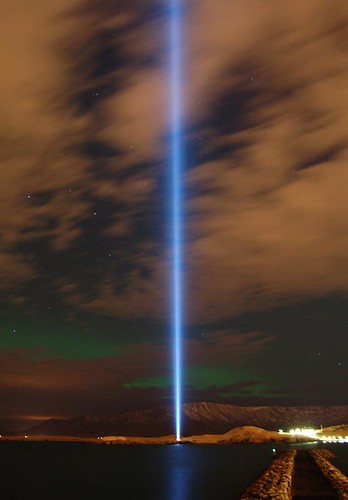
Have Beatles fans finally learnt to love Yoko Ono? She talks about building a tower of light for Lennon
http://entertainment.timesonline.co.uk/tol/
arts_and_entertainment/music/article6887223.ece#

Labels: , ,

Friday, June 19, 2009

Yoko Ono - Interview 2009

"Meine Arbeit zu kritisieren, hat immer noch eine starke Tradition in der Kunstwelt" art sprach exklusiv mit der japanischen Künstlerin Yoko Ono in New York

Hamburg (ots) - Seit mehr als 40 Jahren lebt Yoko Ono mit den Sonnen- und Schattenseiten des Berühmtseins und galt jahrzehntelang als Drachenfrau, Hexe oder Spalterin der Beatles. 29 Jahre nach dem Tod von Beatles-Mitglied John Lennon scheint die 76-jährige Yoko Ono wieder als Künstlerin wahrgenommen zu werden. Auf der Biennale in Venedig wurde sie mit dem Goldenen Löwen für ihr Lebenswerk ausgezeichnet. Das Kunstmagazin art traf Yoko Ono in New York und sprach mit ihr exklusiv über ihren künstlerischen Werdegang.

Es war eine schwierige Anfangszeit für die in Japan geborene Künstlerin, die sich nicht unterordnete und kontroverse Kunst machte. "Es hat mich schon immer interessiert, die Dinge aufzurütteln", so Yoko Ono. Ihre gemeinsam mit John Lennon produzierte Musik und die Mission als Friedensbotschafter verband das Paar Ono-Lennon, überschattete jedoch über viele Jahre die eigentliche künstlerische Arbeit der Japanerin. Umso mehr scheint es sie zu berühren, dass ihr Lebenswerk nach fast 50 Jahren mit dem Goldenen Löwen ausgezeichnet wird und Yoko Ono gibt zu, dass sie überrascht und glücklich darüber ist, dass keine Angst gezeigt wurde, sie zu nominieren, denn ihre Arbeit zu kritisieren, habe immer noch eine starke Tradition in der Kunstwelt.

Der Künstler George Maciunas ermöglichte der jungen Frau 1961 ihre erste öffentliche Ausstellung und prägte den Begriff der Fluxus-Bewegung. Als Fluxus-Künstlerin war Yoko Ono dafür bekannt, dass sie den Betrachter mit Anweisungen herumkommandierte. Zu ihren berühmtesten Arbeiten zählt die Performance "Cut Piece", die sie zwischen 1964 und 1966 in Japan, in New York und London und 2003 ein letztes Mal in Paris aufführte. Yoko Ono forderte die Besucher auf, ihr Stück für Stück die Kleider vom Leib zu schneiden. Mit dieser Arbeit verbindet die Künstlerin eine für sie sehr wichtige Aussage: "Du willst kein Opfer sein, obwohl sie versuchen werden, ein Opfer aus dir zu machen."

Yoko Ono musste über viele Jahre mitansehen, wie männliche Kollegen mit ähnlichen Arbeiten mehr Beachtung fanden als sie und zahlreiche Lügen über sie und ihren Mann auf der ganzen Welt verbreitet wurden. "Wenn ich das an mich herangelassen hätte, wäre ich als Mensch gestorben", erklärt sie. Warum sie bereits in ihren frühen Arbeiten einen starken feministischen Standpunkt vertrat, begründet Yoko Ono mit folgenden Worten: "Ich bin Feministin, weil ich Mensch bin. Was dir angetan wird, sollte dich bestürzen. Weil sie so viel Angst haben, sind die Leute jedoch nur halbe Menschen." Und sie fügt hinzu: "Ich mache das alles, um ein vollständiger Mensch zu sein."

art ist Europas größtes Kunstmagazin und Marktführer im Segment der Kunstzeitschriften. Die monatlich erscheinende Zeitschrift informiert auf journalistisch anspruchsvolle, verständliche und unterhaltsame Weise über alle wichtigen Ereignisse, Entwicklungen und neuen Trends der internationalen Kunstszene. Neben Malerei, Plastik und Architektur wird auch über jüngere Gattungen wie Fotografie, Videokunst, Design und CrossCulture berichtet.

Pressekontakt:
Maike Pelikan
art Marktkommunikation
20444 Hamburg
Tel: 040/3703-2157, Fax: 040/3703-5683
E-Mail: presse@art-magazin.de

source: http://www.presseportal.de/pm/7370/1425580/gruner_jahr_art

Labels: , ,

Saturday, April 18, 2009

Montreal Museum Celebrates Peace Ballad Of John, Yoko

In 1969, John Lennon and Yoko Ono’s famous Bed-in, held from May 26 to June 2 in Suite 1742 of Montreal’s Queen Elizabeth Hotel, made headlines around the world. Forty years later, through June 21, 2009, the Montreal Museum of Fine Arts will celebrate this legendary event with Imagine: The Peace Ballad of John & Yoko, organized in collaboration with Yoko Ono.

This multidisciplinary exhibition, designed and mounted by the Montreal Museum of Fine Arts under the direction of Nathalie Bondil, will be presented exclusively in Montreal. Rekindling the philosophy behind John Lennon and Yoko Ono’s commitment for today’s world, this comprehensive exhibition will provide a picture of the historical and political context in 1969 that formed the backdrop to the Bed-in, as well as explore the wide-ranging artistic and musical dialogue in the name of peace conducted by the pop icon and the conceptual artist with ties to the Fluxus group.

In order to enable the widest possible public to understand, be moved by and perpetuate this still-topical peace message, admission to the exhibition will be free at all times.

"The work of Yoko Ono has revolutionized the language of art and will remain a source of inspiration for generations to come." AFP

Peace activist Yoko Ono is being awarded a prestigious Golden Lion for Lifetime Achievement on June 6, 2009, at this year's Venice Biennale.

Just as in the exhibition Warhol Live, sound, at once an emotional and educational conduit, will occupy a privileged position within this exhibition. This soundscape will closely reflect the entire thrust of the exhibition. From one gallery to another, John and Yoko whisper, murmur, speak, sing, shout, call each other and, most of all, remind us that they often acted as one. For the first time ever, it will be possible to hear excerpts of conversations between the two artists during the recording of songs like “Give Peace a Chance”(three different versions were recorded), as well as media interviews, video excerpts from the 1960s for such anthems as “Power to the People”and “I Dont Wanna Be a Soldier.” The soundscape will also correspond to the record covers, which are at once artistic and autobiographical statements.

Some 140 works, drawings, unpublished photographs, videos, films, artworks and interactive materials will convey the famous couple’s message of universal peace. Furthermore, visitors will be able to play “Imagine” on a white piano with a Disklavier sound system, write down their wishes and tie them to Yoko Ono’s Wish Tree, stamp “Imagine Peace” on maps of the world, and read the works of certain Nobel Peace Prize winners.

“The Museum is offering a spring of peace,” explains Nathalie Bondil. “Thanks to the participation of Yoko Ono, this exhibition, while commemorating the1969 Bed-in, which took place in Montreal, will renews their pacifist action in the present, an action made all the more relevant given the current state of the world. In solidarity, an incredible number of businesses, suppliers and partners have decided to support this project by offering their services for free, so as to spread this universal message, which, it goes without saying, extends beyond the walls of this institution. I am very touched to report that this inclusive and collaborative approach is gathering great momentum, transforming this event into a collective Montreal work and a socially engaged action, with all of us rallying around the same philosophy.”

Made possible through Yoko Ono’s loan of many exceptional works, the exhibition will retrace the story of these two major figures, from their meeting in 1966 to their first creations promoting peace, which culminated in the May 1969 Bed-in during which “Give Peace a Chance” was recorded. it will examine the legacy of such anthemic songs as 1971’s “Imagine” and “Power to the People,” as well as the politically engaged 1972 album Some Time in New York City.

Organization of the exhibition

The exhibition will comprise nine sections organized on a thematic and chronological basis. The Introduction will present the life of John Lennon and Yoko Ono. The 1966 Meeting will reveal the circumstances in which John and Yoko met, and John’s discovery through Yoko of the American counterculture and conceptual art. In Four-Handed Works 1969-1971, we follow the rich artistic dialogue that developed between John and Yoko. In 1968, they presented their first happening and John had his first solo exhibition; the Plastic Ono Band was born. The 1969 Bed-In follows John Lennon’s engagement in protests against the Vietnam War, in the tradition of Martin Luther King, Jr., and of Ghandi: the Bed-in as political forum, the stage for experimental art and even a recording studio.

War Is Over if You Want It! 1969 traces the international advertising campaign championing peace in twelve cities worldwide. Imagine 1971: John Lennon and Yoko Ono’s political message comes through on the album Imagine, the second of John Lennon’s solo albums offering a new dream of a peaceful world. Some Time in New York City – 1971-1972: John and Yoko settled in New York, where they hung out with Bob Dylan, Jerry Rubbin and Abbie Hoffman, as well as the leftist leaders of the Youth International party and the Black Panther Party. They played active roles in many political protests and recorded Some Time in New York City, an echo of their political activism. This was also the year they were expelled from the United States. John Lennon had to wait four years to receive his green card, which affected his relationship with Yoko as well as his political activism. The Peace Library invites visitors to explore the many works by a great number of authors who have written on the theme of peace. Contemporary Works by Yoko Ono will conclude the exhibition will the Wish Tree, a series of works she began in 1990, which offers visitors the opportunity to experience a moment of meditation, and the chess game Play by Trust.

A bit of background

Following their wedding at the British Consulate in Gibraltar on March 20, 1969 – itself a performance/statement in a youth culture rejecting the traditional institution of marriage – John Lennon and Yoko Ono flew to Amsterdam to devote their honeymoon to the first Bed-in for peace, from March 25 to 31, at that city’s Hilton Hotel. Their second Bed-in, which could not be held in the United States since John Lennon was denied entry, was staged in Montreal from May 26 to June 2, involving LSD guru Timothy Leary, singer Petula Clark, Rabbi Abraham Feinberg and hundreds of reporters. Knowing that their honeymoon would be a magnet for paparazzi, the couple decided to turn it into a public event to advance the cause of peace. The normally private, personal bed became a public stage, a podium, a forum where, dressed in pyjamas, they explained their perspective on the Vietnam War to the world’s press.

On December 15, 1969, John Lennon and Yoko Ono launched an international advertising campaign for peace in twelve of the world’s major cities: Athens, Berlin, Hong Kong, London, Los Angeles, New York, Paris, Port of Spain (Trinidad and Tobago), Rome, Tokyo, Toronto and, once again, Montreal. Huge billboards in each national language went up in strategic locations, proclaiming “WAR IS OVER! If you want it. Happy Christmas from John and Yoko.” The format varied with the available space, ranging from immense billboards in New York’s Times Square to posters and handout flyers, all bearing the same message. The campaign kicked off with the “Peace for Christmas” benefit for UNICEF at London’s Lyceum Theatre on that same December 15, with the Plastic Ono Band assembling George Harrison, Eric Clapton, Klaus Voormann and Keith Moon of the Who for the occasion. The following day, John and Yoko took the peace campaign to Toronto, and met with Pierre Elliott Trudeau, Prime Minister of Canada. On December 21, an ad with their “War is over” message appeared in the New York Times.

The Bed-in was the high point of John Lennon and Yoko Ono’s actions for peace, which owed their efficacy to both communications strategies and contemporary performance art issues. Like their performances, these uncategorizable actions were generally rejected as gags or self-promoting theatrics by publicity-hungry stars. In the same vein as Andy Warhol founding Interview magazine or Joseph Beuys and the German Green Party, the couple demonstrated a keen awareness of how to use and channel popularity and manipulate the media.

Yoko Ono

Today, Yoko Ono is still actively pursuing the career in art she began close to fifty years ago. The latest retrospective of her work, Between the Sky and My Head, was recently presented in Germany and is currently on show in England. In 2004, she mounted a controversial exhibition of photographs depicting parts of women’s bodies. Born in Japan, this avant-garde artist associated with the Fluxus movement has never ceased to promote peace in her works, from those in the 1966 Indica Gallery exhibition where she first met John Lennon, to those shown throughout the world today.

A “conscientious objector” during a time of societal and political crisis throughout the world, John Lennon, along with his muse and alter ego, Yoko Ono, sang a message of hope and tolerance that sought the transformation of violence into peace, and hate and racism into love. Forty years after the iconic Montreal Bed-in, this four-handed work composed by John Lennon and Yoko Ono still speaks to us today. The tremendous explosion of media and public attention that surrounded “Beatlemania” often overshadowed the innermost voice of John Lennon, who, even as a child, believed he would be an artist and poet who would use a gift for words and humour and the power of a somewhat surrealistic imagination to build a world of magic again. Imagine, far from consigning the artist to the past, will endeavour to make his creative process come alive and let the voice of this extraordinary witness to his times be heard.

Labels: ,

Tuesday, January 13, 2009

Yoko Ono - is her art any good?

Sadly not, if the latest retrospective of her work is any guide.
By Alastair Sooke
Last Updated: 8:05AM GMT 13 Jan 2009

Yoko Ono has a good claim to being the most despised woman of modern times. For decades, she has been caricatured as the wicked witch of rock and roll who broke up the Beatles and stole away John Lennon. Today, at 75, she still lives in the splendid Upper West Side apartment that they shared in New York's gothic Dakota Building, outside of which Lennon was shot in 1980.

But, long before she met the most gifted member of the Fab Four in London's Indica Gallery in 1966, Ono was an artist in New York, fraternising with avant-garde creative types such as the composer John Cage (she was part of the Fluxus movement of artists), and hosting concerts attended by the likes of Robert Rauschenberg, Jasper Johns and Marcel Duchamp in her loft in downtown Manhattan.

A new retrospective, Yoko Ono: Between the Sky and My Head, which opened recently at the Baltic art gallery in Gateshead, features 50 pieces stretching back to 1961, and attempts to make the case that she was a pioneering figure in the development of conceptual and performance art who deserves to be remembered as a radical practitioner in her own right, and not simply as the wife of a Beatle. Lennon was convinced that his Japanese wife was a trailblazing genius; Baltic's curators take this as gospel fact.

Looking around the exhibition, though, it's hard not to reflect that Lennon's praise was surely the by-product of his infatuation, rather than an objective measure of Ono's artistic worth. As an artist, Ono undoubtedly has her moments; but, for the most part, her work is muddled by the kind of whimsical freethinking that is a hangover of the Sixties and Seventies, and which today seems fey, pretentious, out of touch and out of date. "Imagine Peace" screams a billboard that dominates Baltic's vast north facade, overlooking the River Tyne, serving as a come-on and mantra for Ono's show (and entire oeuvre). Sure, who wouldn't give their right hand in exchange for everlasting global harmony? But try sticking a poster with that slogan in Gaza City at the moment, and see how far it gets you.

Underneath the hippy claptrap, there is a talented artist who occasionally muscles her way to the forefront, but whether you can be bothered to hang around for those moments is another matter.

Let's start with the good. The strongest work in the show is Cut Piece, a performance presented here in two incarnations: a film of Ono performing the piece at the Carnegie Hall in New York in 1965, and a film of another performance of the same work nearly four decades later in a Paris theatre. In both cases, Ono sits on stage against a black backdrop. Throughout, she is silent, immobile and impassive, like a piece of ancient Egyptian funerary sculpture, while members of the audience take it in turns to approach her and cut at her clothing with a worryingly large pair of tailor's shears.

The films are compelling and disturbing at the same time, and somehow voyeuristic, as though the performance is a sublimated representation of some awful scene of rape or domestic abuse. It is upsetting to see more bullish male audience members hack away at the silk straps and delicate gauze of Ono's underclothes with breathy gusto.

Cut Piece, which dates from 1964, chimes with contemporary feminist thinking, of course, asking us to reflect on the subjugation of women. But, more importantly (and this is why the piece has lasted), it forces us to confront the capacity for violence within ourselves, bringing us face-to-face with primal, semi-bestial urges that we might like to excise from definitions of what it means to be human. Those men and women wielding the shears: they are you, and me.

Fly, a video work from 1970, is similarly unforgettable. Over six screens and 25 minutes, a camera records in close-up the movements of a tiny black housefly as it crawls and prances across the body of a naked woman. Again, the woman is noticeably passive; again, the piece has feminist overtones: it was supposedly inspired by Ono's memory of a man comically unable to stop himself ogling a woman's breasts, and it presents the female form, with its fleshy hillocks and ravines, as a landscape, a patriarchal conceit that has come naturally to male writers and artists since way back when.

But the work also has unsettling associations that, as in Cut Piece, by implication incriminate the viewer. Why does the woman not swat at the fly? Is she a corpse? And, if I enjoy watching the film, does that make me a peeping tom? Fly is a critique (and parody) of male sexual desire.

Ono made most of her best work during the Sixties and Seventies. Some of the later stuff, by comparison, feels slight. We're All Water, from 2006, consists of 118 glass bottles sitting side by side on a long shelf. Each bottle is two-thirds full of water and has been labelled, almost at random, with the name of someone famous, from Sid Vicious to Hitler to Virginia Woolf (her surname is misspelt) to Ono herself.

A piece like this lives or dies on the strength of the concept behind it; making art out of the truism that, after death, we are all the same feels hackneyed and banal, and wilfully ignores the interesting and complex thing about human identity, which is that we are all unique. Other than the fact that two thirds of their body mass consisted of water, in what ways were the frontman of the Sex Pistols and the pre-eminent writer of the Bloomsbury set similar? This is the equivalent of making art that says: hey, humans share 60 per cent of their DNA with fruit flies. Whatever.

Play It By Trust, a giant chess set made using sleek Carrara marble (the material of Michelangelo's David) last year, is another example of Ono's recent folly. The piece is a version of a set she showed in London back in '66; the gimmick is that all the chessmen are white, so that the set is effectively unplayable. The pacifist message is clear: make love, not war. But reprising this neat if one-trick idea in expensive Italian marble is an extravagance. The forms of the chessmen are visually alluring and tactile, of course, but to what end? I couldn't help but feel that this sculptural work was a kind of con.

"I don't think the poor bastard will get recognition until she's dead," John Lennon once said of his wife.

I'm not so sure she'll get it even then. Except for a handful of examples where Ono has struck artistic gold, the work on show at Baltic feels slender and slight, and too muted and tasteful to really stake a claim to longevity.

Lennon also called Ono "the most famous unknown artist in the world: everybody knows who she is, but nobody knows what she does". I suspect that this isn't about to change.

'Yoko Ono: Between the Sky and My Head' is at Baltic Centre for Contemporary Art, Gateshead (0191 478 1810), until March 15.
source: Telegraph.co.uk

Labels:

Friday, January 02, 2009

Wish

Message I recieved from Yoko Ono Lennon - New Year’s Eve 2008


ON ENTERING THE AGE OF JOY
Dear Friends
This last day of the year 2008
All of us can come together at www.IMAGINEPEACE.com
To enjoy spectacular images from the IMAGINE PEACE TOWER Earthcam - LIVE - from Reykjavik, Iceland
- a special program made for this day.
On New Year’s Eve, The IMAGINE PEACE TOWER will be lit from:
Reykjavik: 5pm to 10am
New York : midday to 5am
Los Angeles: 9am to 2am
View the IMAGINE PEACE TOWER Earthcam here
As we enter the New Year, we will be watching the IMAGINE PEACE TOWER and its warm light together.
Know that our light will be sending the light of love to all planets of the Universe as well.
On this day, I wish to express my love for all of us, including other beings on Earth.

AFFIRMATION FOR 2009 AND BEYOND
Thank you, thank you, thank you
Our planet is healthy and whole
Every part of the planet is revitalized and healed.
We, the people of Earth
See clearly, Hear clearly, Think clearly.
Express and communicate our thoughts clearly
Spiritually, Mentally, and physically.
For the benefit of ours and other planets’
We make the right judgement, right decision, right move
at the right time and the right place
for ourselves and others.
We are now bathing in the light of Dawn
Standing in the Heaven we have created on Earth.
We now wish to share this Age of Joy
With all Lives in the Universe.
We are all one, united with infinite and eternal love.
For the highest good of all concerned, So be it.
Yoko Ono Lennon
31 Dec 2008
New Years Eve
More info at www.IMAGINEPEACE.com
Think PEACE, Act PEACE, Spread PEACE.

IMAGINE PEACE TOWER is an outdoor work of art conceived by Yoko Ono in memory of John Lennon.
It is situated on Viðey Island in Reykjavík, Iceland.
The artwork was dedicated to John by Yoko at its unveiling on October 9th 2007, John Lennon’s 67th birthday.
IMAGINE PEACE TOWER symbolizes Lennon’s and Ono’s continuing campaign for world peace
which began in the sixties, was sealed by their marriage in 1968 and will continue forever.
The IMAGINE PEACE TOWER Earthcam takes 30 sec exposures every 5 mins.
Visit the IMAGINE PEACE TOWER Earthcam control center here.
More New Years’ Earthcams here.

Labels: ,

Friday, December 05, 2008

Yoko Ono in Japan


Press Conference for "Dream Power Super Live" in Tokyo, Japan on 12/
Posted by: "mickeyono2005" mickeyono2005@yahoo.com mickeyono2005
Thu Dec 4, 2008 6:20 pm (PST)

Yoko Ono, who is in Japan now, attended the press conference
for "Dream Power John Lennon Super Live" with BONNIE PINK, singer,
at "imagine studio" by Nippon Broadcasting System, Inc. in Yurakucho,
Tokyo, on December 2nd, '08.

"Dream Power John Lennon Super Live" will be held at Nippon Budokan,
Tokyo, Japan, with all-star Japanese musicians.on December 8th, '08,
the 28th anniversary of John Lennon's death.

The following news written in Japanese reports on the press
conference and the performance Yoko presented at the site. I
translated it from Japanese into English.

http://natalie.mu/news/show/id/11382

-- Translation from Japanese into English

Yoko Ono and BONNIE PINK spoke with fervor about the wish for peace

December 2nd, 2008

The press conference of the charity concert, "Dream Power John Lennon
Super Live", which will be held on December 8th, was held today on
December 2nd, '08.

Yoko Ono and BONNIE PINK attended the conference and spoke about the
results of the charities by the same concerts and their enthusiasm
about this year's concert.

At the beginning of the conference, Yoko Ono conveyed her
appreciation for the people who produced the concerts by
saying, "This concert is going to be the 8th anniversary this year,
thanks to the many Japanese rockers, staff and people who support
this. Thank you very much." Also, as to the reasons why she started
the concert, she pointed out three things: that she wanted to give
education which will be the treasure through the lives for children
in developing countries; that she wanted to convey to the world that
Japanese people are assisting developing countries through the
charity concerts like this on individual levels; and that she wanted
to give encouragement to Japanese children who believe "I cannot do
anything."

This year commemorates the 40th year since John and Yoko started
their first peace activity. As to the activities so far, Yoko, who
continued the peace activities even after John's passing, recalled
the road for many years by saying, "I came to realize that I had to
continue what both of us had done even after his passing and that I
had to offer the love I'd given to John to the world. And then, by
continuing the project, I realized that many people started giving me
help."

In the meantime, BONNIE PINK, who will perform at the concert for the
third time this year, spoke of her enthusiasm with a smile, "I look
forward to this because this live concert gives me overwhelming
excitement every year. This live concert is a very happy concert
through which not only can you fully enjoy the songs by John, but
also you can help many new schools to be built by your
participation. I look forward to listening to the songs each
musician will sing. I will also sing the songs I chose with my heart
for this year."

At the end of the conference, an art performance by Yoko Ono was
presented. In this performance, Yoko displayed the fragments of an
urn broken into pieces and the photograph of its original shape. To
the press reporters, she asked for their cooperation by
saying, "Please send this message to those who will receive the
fragments: we will gather together at this place in 10 years and mend
the pieces back to one original shape."

In this performance, Yoko's message asks people who will receive each
fragment (piece) to think about "peace" until they get together in 10
years. The press conference ended by assuring the ideology of "Dream
Power", which is when people's dreams become one, they become a huge
power to change the world.

http://natalie.mu/gallery/show/news_id/11382/image_id/4572

"Dream Power John Lennon Super Live" will be held at Nihon Budokan on
December 8th, the anniversary of death of John Lennon. In addition
to Yoko Ono and BONNIE PINK, Tamio Okuda, Kazuyoshi Saito, Salyu,
Tortoise Matsumoto, Fujifablic, Kazuya Yoshii, etc., will perform.

http://natalie.mu/gallery/show/news_id/11382/image_id/4566

BONNIE PINK who comments (right) and Yoko Ono who looks at her
(left).

http://natalie.mu/gallery/show/news_id/11382/image_id/4569

The fragments of a base which contain wishes.

http://natalie.mu/gallery/show/news_id/11382/image_id/4571

Yoko Ono who displays a peace sign.

http://natalie.mu/gallery/show/news_id/11382/image_id/4568

http://natalie.mu/gallery/show/news_id/11382/image_id/4565

http://natalie.mu/gallery/show/news_id/11382/image_id/4567

Mikihiko Hori

Labels: , , ,

Friday, October 03, 2008

Yoko Ono's career rehab complete

CZAREK SOKOLOWSKI/ASSOCIATED PRESS

Yoko Ono has become a welcome fixture on the global art scene, where once she was the subject of derision. She is seen here at the Contemporary Art Center in Warsaw, Poland, Sept. 17, 2008 where she presented a selection of her work. Once maligned, now revered artist brings star power to Nuit Blanche

by Peter Goddard

Yoko Ono's rehabilitation from Beatles-buster to revered artist is now so thorough that no contemporary art season feels complete without some inclusion of her work or reference to her abiding influence.

Just check out her work at Nuit Blanche tonight (even though she won't be on hand herself).

"I am constantly creating things," she tells me over the phone from her New York apartment in the Dakota, the scene of husband John Lennon's shooting death on Dec.8, 1980. "The art (at Nuit Blanche) is meant to bring joy, encouragement and inspiration to people."

For the event, Ono's Imagine Peace billboard in Liberty Village harks back to her "War is Over!" campaign waged in 12 cities with Lennon in the late 1960s. Much derided at the time for their simple-mindedness, the billboards – along with the couple's bed-ins in Toronto and elsewhere – are now viewed as cornerstones in Ono's emerging "utopian social program," so called by a number of critics.

On Oct.10, Montreal's Musée d'art contemporain opens "Sympathy for the Devil: Art and Rock and Roll Since 1967," organized by the Museum of Contemporary Art in Chicago, where 75-year-old Ono is given a central place in the section titled "Ono, Eno, Arto: Non-musicians and the Emergence of Concept Rock."

Ono's Wish Tree installation is another Nuit Blanche intervention, along with the distribution of 40,000 "Imagine Peace" buttons during the night at the southeast corner of Lamport Stadium, in Liberty Village. With Wish Tree, passersby can write a hopeful phrase on a tiny piece of paper, which can be affixed to a nearby tree. It's an installation she has staged previously.

Wish Tree – also part of a current wide-ranging Ono retrospective in England – is in fact a contemporary projection of one of the artist's earliest childhood memories in Japan, "when I was going to the Buddhist temple and would see all these beautiful white flowers in the bushes," she explains. "In the temple itself you could buy these tiny slips of paper, which said you'd received good health or money or whatever. This was a very old tradition. I liked the idea but I wanted (to make the good-fortune message) in your own handwriting."

Ono's work, with its roots in the process-minded Fluxus movement in New York in the early '60s, has generally avoided the production of objects in favour of exposure of these ideas.

"I know, even now people say I am naive," she says. Her work "seems to bring out the hatred in some people. But I am a rebel. From the start I didn't like the idea that artists had to have such (big) egos that they had to create something that would last an eternity. I went against that (idea). It wasn't my thing."

Her role models in this regard were composers John Cage and Toshi Ichiyanagi, her first husband, as well as avant-garde impresario La Monte Young and artists Larry Poon and Jim Dine. They all hung out at Ono's studio at 112 Chambers St. in New York.

Cage's most famous piece – four minutes and 33 seconds of silence "performed" by a non-playing pianist sitting still before a concert crowd – provided a signpost for Ono and the rest of Fluxus to follow. Indeed, it led to her Ceiling Painting, created by Ono in 1966 for the Indica Gallery in London, where she first met Lennon.

Climbing up a ladder, Lennon peered through a magnifying glass to read the word "yes" printed neatly on the ceiling. The work subsequently provided the title for her retrospective, "Yes Yoko Ono," at the Art Gallery of Ontario six years ago.

Ironically, one of her current projects is to revive interest in Lennon's career as an artist, cut short by his decision to play in a rock 'n' roll band with a silly name.

"I'd always wanted John to do a show," Ono tells me, "but he was always being treated as a pop star, not as a painter."

In recent years, a number of Lennon's acerbic sketches have appeared in galleries, with Ono turning up at openings to help the cause. The next Lennon show could be of 10 or so of his previously unknown watercolours, done in one afternoon while the couple were on vacation at a Japanese resort.

"I have no intention of making any copies (of them) or of selling them," Ono says. "At this point, I just want to do a show."

Peter Goddard can be reached at

peter_g1@sympatico.ca

Labels: , ,

Saturday, September 13, 2008

Interview with Yoko Ono by Michele Robecchi

MICHELE ROBECCHI: You’ve been based in New York since the late 1950s, and have had a unique opportunity to witness very different times and swings – from the Fluxus days through the East Village boom of the 80s and the consequent crisis of the 90s. Do you think that your work has somehow been influenced by these changes through the years? Obviously the audience in the 60s was very different to the audience of the 90s. Do you feel people have perceived your art differently?

YOKO ONO: Well, in a very strange way, I saw Pop Art happening and then Op Art and all that, but I wasn’t affected by it so much, you know. Before that was Abstract Expressionism… When Pop Art was very fashionable – I use the word fashionable which is maybe not fair to them, but it was – people expected Pop Art to be the only thing that you should be doing. If you were not doing that then you weren’t a good artist. But there were still some cult followers of my work; there were always some people who liked this kind of art side of work.

MR: I was especially thinking about the 80s because it is normally assumed that it was a very joyful, if not slightly hedonistic time. I’m talking about the pre-AIDS days, when all of a sudden there was a lot of money involved and many social concerns seemed to be brushed aside.

YO: Well, I was never on that boat. [laughs] I always missed the boat, and that’s fine. It was probably better that I missed it.

MR: Absolutely. I think it’s good to miss the boat sometimes. Were you annoyed by the reaction to My Mummy was Beautiful (2004) at the Liverpool Biennial? (1)

YO: Yeah, I didn’t understand that at all. I was very shocked, because when I thought of the idea, I thought of covering the city of Liverpool with all those beautiful elements of my mother, or motherhood, and I thought it was my way of saying thank you to Liverpool. I wanted to say thank you by giving something. And I thought they would love it, I thought they would love the experience of it. I never thought it was going to create controversy.

MR: Especially for such an image. I mean, Courbet’s L’Origine du Monde is over a century old and one would expect society to have covered some ground after that.

YO: You see, that’s another very interesting thing. You were all born from a woman’s body but you don’t want to think about it, you want to always sweep that under the rug. You don’t want to face a woman’s body on that level. But why? That’s where you came from. I think it has a lot to do with the fact that that’s where the perversion of society starts. In other words, you are debasing women. You have received a lot from women but would like to ignore that. You would like to ignore the power of women in a way, and of course the female sex feels that and their position is one of resentment and anger. It’s not healthy. It’s almost like you’re ignoring or abusing half the world and their energy. If you allow that energy to blossom then it’s better for the world, the world that you live in.

MR: You have a piece here in the exhibition, We are all Water. Is it the same piece you showed in London in 1966?

YO: I think that I first showed it in 1971. It’s basically the same one but here it’s in a different form.

MR: You also did a song called We are all Water at about the same time, which I gather was another evolution of the same concept.

YO: Yes. It was very interesting. I was just inspired to do that. The idea was the fact that we are all the same, just water. So it should be easy for us to communicate. But then Dr Moto discovered not an idea, but the fact that water can understand words and it changes quality when we put certain energies through it. It’s just fantastic – I really like the fact that it was almost like what I was doing was proven by science [laughter], and that gave more legitimacy to it.

MR: Don’t you think it’s crazy that people buy water?

YO: Yeah. Isn’t it amazing? Water is such a basic element. You and I are the same element. Only the container is different. So that’s why I understand you and you understand me. Of course sometimes we are fearful of understanding each other, so we pretend that we don’t. It’s just pretending, you know.

MR: The association of a visual artist like Matthew Barney with a pop star like Björk doesn’t seem to create a stir like it did in your days. Quite the contrary, the art world now seems more receptive to these ‘stardom intrusions’ than in the past.

YO: Yeah, I think it’s great, because we have more freedom that way. Why were we limiting ourselves to one field? I think it had a lot to do with practicality, in the sense that you have to limit yourself to one job and have a name card saying ‘I am an artist’, no, ‘I am a musician’, ‘please hire me’. Especially in the art world, somebody was saying – I don’t think I should actually quote the person’s name, but a pretty important artist was saying that once you establish yourself as an artist in a certain form, then you are known for that, and if you change your ways of expressing yourself you may become less popular and you lose your job in effect. It doesn’t sell anymore. You know how to do this type of painting and you suddenly say, ‘No, I’m going to just do photography’ or something like that, nobody’s going to buy it. So, in a way, it’s establishing yourself as a monetary value.

MR: Where do you think this need to categorise people in this way comes from?

YO: It’s because you want to make sure that you can support yourself and you can make money by your art, and for that you have to say, well, ‘I’m like this, and if you buy my work in five years it might become more expensive.’ It’s like a name card. And, of course, I don’t have a name card.

MR: One of my favourite pieces of yours is the all-white chess set Play It By Trust (1966). I assumed it was about showing that we are all equals, right?

YO: Yes. It’s very much like the We are all Water piece.

MR: But there are different dynamics involved in chess. There is a battle; there is competition.

YO: It immediately dispenses with the idea of war and a battle, because if you are the same, you don’t have a war. Who are we fighting? And why?

MR: Your work for peace in the late 60s left a deep mark. Today war is still a big issue but the majority of artists seem to be dealing with the subject in a different way from the artists of your generation, and you especially.

YO: In what sense?

MR: Well, I get the impression that you were sending a global message in a more propositional and positive way, whereas today artists’ works tend to be more documentary oriented. And I was wondering if this change is more the result of our society growing more cynical, or becoming part of an ‘it didn’t work out that way, so let’s try it this other way’ attitude.

YO: I think both. I really think that many people in the young generation feel that what we did didn’t work. But I say that it did work. I say that if it didn’t work, we wouldn’t have the world now. It helped to keep the world going and also it probably made the world into a more complex and interesting society. Some, in their minds, only focus on the destruction of society. But let’s focus on what we have achieved. We have achieved an incredible, sophisticated civilisation and the ideas in our heads are very, very interesting and wise. I think that when you watch the TV you will see that some of the things talked about by ordinary people could be the words of somebody very special like a philosopher, a guru or a priest in the 16th or 17th centuries. And nowadays it’s just normal for all of us to be just talking like that. Even on TV they are expressing ideas that are very interesting, considering what it was like three or four centuries ago.

MR: So do you think that the media and the evolution of the media have played a role in this?

YO: Well, the evolution of the media has to do with meeting the demand of the people. There is an incredibly strong desire to communicate, and of course communication is everything that we have. I think that exchange and communication, and especially the exchange of information, gives us more and more power.

MR: But at the same time don’t you think it’s overwhelming?

YO: Well, I don’t know, of course we need pause, some time to rest and some time for entertainment. And that’s what I think artists are doing. Artists are doing something that’s two-fold: one is to wake people up, the other is to entertain them. And when I say entertain people it sounds like it’s less of a thing than the effort to wake people up, but it’s not really. Entertainment can be extremely wise and intelligent.

MR: And educational too.

YO: Right – game playing on the level of an exercise for your brain. So I really think in that sense the only hope we have is to try to change society through science and art.

MICHELE ROBECCHI IS SENIOR EDITOR AT CONTEMPORARY

YOKO ONO’S WORK WILL BE FEATURED NEXT NOVEMBER AT RIFLEMAKER, LONDON, ON THE OCCASION OF THE RECREATION OF JOHN DUNBAR AND MILES’ INDICA GALLERY, WHERE ONO ORIGINALLY SHOWED HER WORK IN 1966.

(1) My Mummy was Beautiful consisted of a series of banners, posters and stickers, posted all over the city of Liverpool, depicting a woman’s naked breast and vagina. A BBC poll and a Times inflammatory editorial described the work as offensive, and the fracas eventually resulted in the work being removed from the St Luke War Memorial. Paul Domela, deputy chief executive of Liverpool Biennial, declared that ‘We were aware that some would object to it. But, at the same time, we realised that a great many would love it as well […] In the campaign for the election in the European Union, there was an image of a woman breast-feeding. The campaign was aired across Europe, including some very Catholic countries. Over here, the difference was that the nipple was removed. This baby had its mouth open into nothingness. What does that say about the relationship we have in this country to motherhood? To begin to think about that and talk about it is very important.’

above copied from: http://contemporary-magazines.com/music84.htm

Labels: ,

Friday, August 22, 2008

Yoko Ono in Kunsthalle Bielefeld (Germany)


Several cat sculptures called 'Bastet' created by artist Yoko Ono are shown at Kunsthalle Bielefeld. EFE/Oliver Krato.

BIELEFELD, GERMANY.-Yoko Ono, born in 1933 in Tokyo, is one of the pioneers of Conceptual Art. In 1952, she became one of the first women in Japan to study philosophy. In 1953 she took composition courses at Sarah Lawrence College in Bronxville, NY, and studied creative writing at Harvard. In the mid-1950s, Yoko Ono lived in New York City, where she knew John Cage, and many other artists and composers. In 1960, she rented a loft on Chambers Street, and together with La Monte Young, organized a series of concerts, attended not only by young musicians and artists, including Robert Rauschenberg, Jasper Johns and Fluxus founder George Maciunas, but also by Marcel Duchamp, Max Ernst, Peggy Guggenheim, and Isamu Noguchi.

On her mother’s side, Ono is a member of one of Japan’s most respected families, and so, as a child, she attended a school for members of the Japanese imperial family. Her father, who originally intended to be a pianist before he ultimately became a leading Japanese banker, insisted she take piano and voice lessons at an early age. Her parents and relatives acknowledged that Yoko had a strong will and an irrepressible desire for freedom. The lengthiest publication on the artist to date says that her main intention was “to think the unthinkable—and then do it.” After beginning a relationship with John Lennon in 1967, Ono began working on no less an ambition than to bring inner peace to different peoples. Representing one of her chief messages, her work Imagine Peace will be presented in front of the Bielefeld Kunsthalle.

As a young artist, Ono left New York in the early nineteen-sixties in order to return to Japan. During this period she performed several concerts with John Cage and the pianist David Tudor. In 1962 at the Sogetsu Art Center in Tokyo, she began hanging texts, instead of the pictures she had shown in 1961 at the AG Gallery in New York. Her work in conceptual art manifested in the famous collection of works, Grapefruit, which she first published herself on July 4, 1964 in Tokyo. It went on to be published in several editions. Some of the works in it date back to 1953. The book divided her oeuvre into chapters dealing with music, painting, happenings, poetry, and objects, documenting her affinity for all categories of art. To this day, she has remained interested in the process of tearing apart various forms of presentational media to the point where their boundaries dissolve.

Therefore, for the 2008 exhibition in Bielefeld (featuring a selection of Ono’s work from 1961 to the present), works placed outside the museum will relate to the city itself. One of these will be a Wish Tree. The Wish Tree differs greatly from the “wish pieces” in Japanese temple gardens or the “fortunes” in Chinese fortune cookies. While those preprinted prayers and fortunes are materialistic, the Wish Trees invite the public to express hopes and dreams. Just before the opening of the exhibition, children and teens from three schools in Bielefeld will hang their wishes on a selected tree outside the Johnson building.

A Golden Ladder, which is an allegory for the exhibition’s title, Between the Sky and My Head, will be installed in the Kunsthalle park. The work is an imaginary, spiritual space centered between sky and earth Since Ono works not only with grand dreams, but also with poetic visions of how one can change, she plans a third work that will take place outside the Kunsthalle. It will be the realization of a work she originally noted down in 1962: titled Riding Piece “Ride a coffin car all over the city.” During the run of the show, visitors to the Kunsthalle can decide to be chauffeured around the city in a hearse for a short time.

Inside the Kunsthalle, visitors will experience three floors of sculptures, paintings, drawings, photographs, films, and sound installations. An interview with the artist, filmed in Bielefeld, will accompany the exhibition. One of the earliest works is Cough Piece, first written down in 1961; and Keep Coughing a Year, a sound installation featuring the artist’s cough and other sounds, will be heard in dark rooms. Laughing and coughing were important anchors in Ono’s work at the time she began creating conceptual art: they considerably expand the sense of time during a performance. In the entrance to the Kunsthalle is Play It by Trust, a chess game that has been set up several times in various places since 1966. In Bielefeld, it will be in marble, with chess pieces one meter high, on a surface measuring five by five meters. One can imagine playing the game with the heavy, fragile marble pieces, all of which are white. Morning Beams, consisting of one hundred nylon threads running throughout all of the floors of the Kunsthalle, illuminates the twelve-meter-high staircase. Since the mid-1990s, Ono has been working with ink on paper, and the show will feature a drawing called Franklin Summer. Other pieces in the exhibition include a labyrinth made of Plexiglas, titled Amaze; the famous film Fly, showing a fly on a woman’s body in a six-part installation; and a participatory piece, My Mommy is Beautiful, in which visitors are invited to put photographs and other thoughts of their mothers onto the bare canvas of the work, or other feelings that they themselves write.

Yoko Ono. Between the Sky and My Head will be accompanied by an exhibition catalogue. To celebrate the re-opening of the sculpture park on 27 September, 2008, at 6 p.m., the work Golden Ladder, made in Bielefeld at Ono’s behest, will be installed on a temporary basis.

Yoko Ono. Between the Sky and My Head will run until 16 November, 2008, and is sponsored by the Kulturstiftung Pro Bielefeld

source: http://www.artdaily.org/index.asp?int_sec=11&int_new=25698

Labels: , ,

Thursday, April 17, 2008

Yoko Ono New Expo


Yoko Ono

Touch me April 18 – May 31, 2008opening reception: Friday, April 18, 6 to 8 pmIn touch me, Yoko Ono will present an interactive painting, film, conceptual photography and sculptures that comment on different facets of the female experience, calling upon the viewers to make direct and deeply personal connections. Ono’s first New York exhibition since Odyssey of a Cockroach at Deitch Projects in 2003, touch me affords the audience an opportunity to experience her work in a new way. The exhibition will open to the public at Galerie Lelong on Friday, April 18, from 6 to 8 pm.

For over 40 years, Yoko Ono’s works have defied categorization, existing in the interstices between performance, music, objects and film. As one of the first conceptual artists, and one of the founders of Fluxus—an association of experimental, interdisciplinary artists and writers in the ‘60s and ‘70s—Ono is cited as a major influence on contemporary artists. She has redefined the boundaries between various movements: conceptual art, performance art, feminist art, and more. Many of her actions have bridged the distance between art and audience participation—which has always been a hallmark of Ono’s work.

A participatory element is central in touch me, in which Ono urges the audience to revitalize and rethink a personal connection to the most current situation women are facing. The centerpiece of the exhibition will be a large canvas covering the entire width of the gallery. Openings will be cut into the canvas, and viewers are invited to insert body parts through. Encompassed in this simple act are opposing elements of isolation, exposure, vulnerability, and defiance. The viewer will have the option to photograph themselves with supplied cameras; these photos will be displayed together on another canvas with the participant’s own comments and thoughts written underneath the photos, furthering the inclusive nature of this new work. A 4-screen installation version of Yoko Ono’s 1964 performance Cut Piece, filmed at Carnegie Recital Hall in 1965, will act as a counterpart for the metaphoric 2008 work.

Complementing this contemporary work will be Vertical Memory, in which a composite of a male face—combining Ono’s father, husband and son—is contrasted with the artist’s succinct and moving texts describing her passage from birth to death. Also on view will be Memory Paintings, intimate 19th-century portraits of women; and a sculpture from the series “Family Album (Blood Objects),” representing her mother. Sky TV will serve as an anchor of hopefulness to the entire exhibition touch me.

In addition to having received the College Art Association’s 2008 Distinguished Body of Work Award, she is also the recipient of the 2002 Skowhegan Medal for Assorted Mediums. Solo exhibitions have recently been presented at the Centro Cultural Banco do Brasil (Sao Paulo), Kunsthalle Bremen, Berkeley Art Museum, Museo di Santa Caterina (Treviso, Italy), and Portikus im Leinwandhaus (Frankfurt), among other venues. She is featured in WACK! Art and the Feminist Revolution, organized by the Museum of Contemporary Art, Los Angeles, and currently on view at P.S.1 Contemporary Art Center, New York. This August, the Kunsthalle Bielefeld will present a solo exhibition of Ono’s work, entitled Last Supper.

Labels: ,

Thursday, March 06, 2008

Grapefruit by Yoko ONO


Book with instructions by Yoko Ono

Labels: , ,

Tuesday, February 19, 2008

Yoko Ono when she was young

Labels:

Monday, February 18, 2008

Yoko Ono at 75 admits it: she's a witch


Yoko Ono at 75 admits it: she's a witch

Monday Feb 18 15:34 AEDT

Yoko Ono doesn't have it easy. Even today, hardcore Beatles fans still blame her for the break-up of the band considered by many to be the best pop group of all time shortly after her marriage to John Lennon nearly 40 years ago.

She's been berated as the evil witch in the Beatles fairy tale and as a woman who was only after riches when she married the legendary singer and songwriter whom many consider the Beatles' heart and soul.

Ono doesn't seem bothered by the accusations. To the contrary, she plays along. Last year, she brought out a remix album of old songs entitled Yes, I'm a Witch. She says she considers all women witches and all witches magical beings. Women shouldn't be ashamed of that, says Ono, who turned 75 on Monday.

Petite, lively and bursting with energy, Ono has not lost her provocative nature. Ono, who came from a wealthy Japanese banking family, continues to work tirelessly as an artist, author, filmmaker, singer, composer, feminist and pacifist.

But Lennon remains the reference point of her life. She still lives in the New York City apartment where they were residing when Lennon was gunned down in December 8, 1980, at the age of 40. Ono was present when the gunman, Mark David Chapman, a one-time fan, shot Lennon five times. A photo of Lennon's broken, blood-splattered glasses appeared on the cover of her 1981 album, Season of Glass.

The apartment has become Ono's refuge. She says it is significant to her because it is the place that she and Lennon shared.

The two met in 1966 at an art exhibit opening in London and later began a productive artistic relationship.

They married in Gibraltar on March 20, 1969. During their honeymoon, they stayed in their hotel bed for a week, declaring the action a "bed-in for peace" at a time when the anti-Vietnam War movement of the 1960s was climaxing.

They collaborated on a mix of rock and experimental music in the Plastic Ono Band, and the single Give Peace a Chance in 1969 became a pacifist anthem. Shortly after that, the Beatles broke up.

Lennon best expressed his love for Ono, who was seven years his senior, in the song Ballad of John and Yoko. But the relationship also had difficulties.

After a two-year separation, the birth of their son, Sean, in 1975 helped create a new feeling of family togetherness. Lennon stayed home with the child while Ono organised and directed his empire, something she is still doing today with great success.

Lennon once said Ono was the most famous unknown artist in the world. Everyone knows her name, he said, but no one knows what she does.

Before meeting Lennon, Ono had established herself as an avant garde concept artist in New York. In 1962, for example, she staged the Wall Piece for Orchestra, in which she continually banged her head on the stage to musical sounds, and her 80-minute film Bottoms, released in 1966, showed 365 naked back sides as a petition against the Vietnam War.

She marked the millennium with a piece called Freight Train, in which she rolled the wagon of a train pocked by 4,000 bullet holes into Berlin in a reference to a millennium of violence.

source: http://news.ninemsn.com.au/article.aspx?id=172609

Labels: , , , , ,

Friday, November 09, 2007

Yoko Ono and Fluxus scholar Jon Hendricks play chess


Credit: NATHAN COLLINS -- THE TECH

Yoko Ono and Fluxus scholar Jon Hendricks play chess at Ono’s 1997 “Play It By Trust” last Friday at the List Visual Arts Center. “YES Yoko Ono,” on which Hendricks consulted, features Ono’s work from the 1960s to present.


Labels: , , , ,

Thursday, September 27, 2007

Yoko Ono As An Artist - Yoko Ono As An Artist

Well before she emerged into popular awareness as John Lennon's wife, Yoko Ono had established herself in vanguard art and music circles as one of the most daring, innovative and eccentric artist-performers of her time. As one of the founders of the Fluxus movement at the beginning of the 1960s, Ono helped identify and define the playful, subversive, visionary sensibility that has undergirded experimentation in all the arts ever since. Her poem-like verbal scores, her films, and her staged performances anticipated everything from minimalism to performance art, the furthest reaches of new cinema to the most extreme of Punk-New Wave music. Her performances made signal contributions to what Fluxus mastermind George Maciunas called "neo-Haiku theater" and artist-historian Ken Friedman labelled "Zen vaudeville".
In the '60s Ono took the common housefly as an alter ego. Clearly, the artist, mocked and maligned long before she began attracting the misguided ire of rock fans, regards the fly as an embodiment of her public persona--its apparent insignificance counterbalanced by its outsize ability to annoy. But even more important to Ono's associative thinking is the fly's constant, nervous "performing" and its elusively melodious buzz.
With her Fluxus colleagues Ono has elevated the insubstantial to monumental status, allowing us to contemplate the magic of the ordinary, as well as to comprehend the ordinariness of the seemingly profound. This inversion, along with the inventive puckishness of her game-like concepts and activities, make her work endlessly provocative--at once irksome and inviting, loopy and lovely, teasing and teaching us to appreciate the intimate and elusive phenomena that comprise life.

Labels: ,

Saturday, September 22, 2007

Life in Fluxus

Life in Fluxus
by : Arthur C. Danto

source: http://www.thenation.com/doc/20001218/danto

John Lennon once characterized his wife, Yoko Ono, as the world's "most famous unknown artist. Everybody knows her name, but nobody knows what she does." What she was famous for, of course, was him. The art for which she was unknown could not conceivably have made her famous--although even the most famous of artists would be obscure relative to the aura of celebrity surrounding the Beatle of Beatles and his bride. Yoko Ono had been an avant-garde artist in New York and Tokyo in the early 1960s, and part of an avant-garde art world itself very little known outside its own small membership. The most robust of her works were subtle and quiet to the point of near-unnoticeability. One of her performances consisted, for example, of lighting a match and allowing it to burn away. One of her works, which she achieved in collaboration with the movement known as Fluxus, consisted of a small round mirror which came in an envelope on which YOKO ono/self portrait was printed. It belonged in Fluxus I--a box of works by various Fluxus artists, assembled by the leader and presiding spirit of the movement, George Maciunas. But the contents of Fluxus I were themselves of the same modest order as Self Portrait. We are not talking about anything on the scale, say, of Les Demoiselles d'Avignon. We are speaking of things one would not see as art unless one shared the values and ideologies of Fluxus.

Fluxus, in that phase of its history, was much concerned with overcoming the gap between art and life, which was in part inspired by John Cage's decision to widen the range of sounds available for purposes of musical composition. Cage's famous 4'33'' consisted of all the noises that occurred through an interval in which a performer, sitting at the piano, dropped his or her hands for precisely that length of time. A typical Fluxus composition was arrived at by selecting a time--3:15, say--from the railway timetable and considering all the sounds in the railway station for three minutes and fifteen seconds as the piece. As early as 1913, Marcel Duchamp made works of art out of the most aesthetically undistinguished vernacular objects, like snow shovels and grooming combs, and he was in particular eager to remove all reference to the artist's eye or hand from the work of art. "The intention," he told Pierre Cabanne in 1968, "consisted above all in forgetting the hand." So a cheap, mass-produced object like a pocket mirror could be elevated to the rank of artwork and be given a title. How little effort it takes to make a self-portrait! In The Republic Socrates made the brilliant point that if what we wanted from art was an image of visual reality, what was the objection to holding a mirror up to whatever we wished to reproduce? "[You] will speedily produce the sun and all the things in the sky, and the earth and yourself and the other animals and implements and plants." And all this without benefit of manual skill!

Fluxus made little impact on the larger art world of those years. I encountered it for the first time in 1984, at an exhibition held at the Whitney Museum of New York in which the art made in New York in the period between 1957 and 1964 was displayed. It was a show mainly of Pop Art and Happenings; and there were some display cases of Fluxus art, many of them objects of dismaying simplicity relative to what one expected of works of art in the early 1960s, exemplified by large heroic canvases with churned pigment and ample brush sweeps. Maciunas spoke of Fluxus as "the fusion of Spike Jones, vaudeville, gag, children's games and Duchamp"; and the display cases contained what looked like items from the joke shop, the children's counter in the dime store, handbills and the like. Ono's relationship to Fluxus is a matter of delicate art-historical analysis, but if she fit in anywhere, it would have been in the world Maciunas created around himself, where the artists and their audience consisted of more or less the same people. It was a fragile underworld, easy not to know about. Ono's work from that era has the weight of winks and whispers.

Labels: , , , ,


(c) 2006-2010 by Fluxus Heidelberg Center